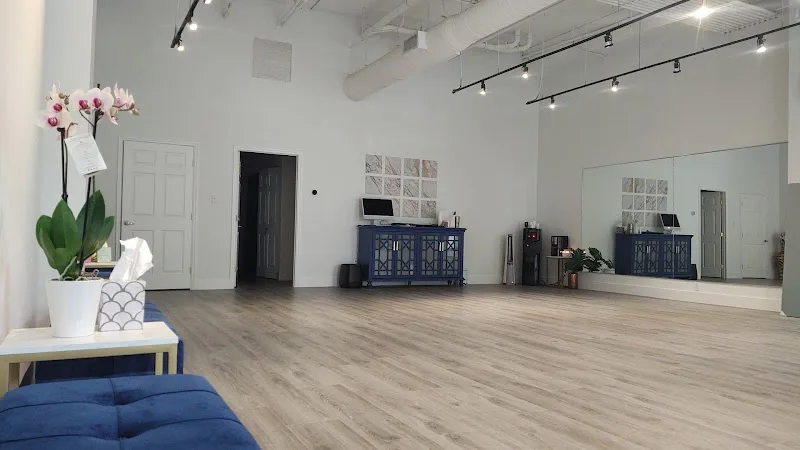
In Motion Ballroom
Address
1155 Main Street
Jupiter, Florida 33458
Opening Hours
- Monday: 11:00 AM - 8:00 PM
- Tuesday: 11:00 AM - 8:00 PM
- Wednesday: 11:00 AM - 8:00 PM
- Thursday: 11:00 AM - 8:00 PM
- Friday: 11:00 AM - 8:00 PM
- Saturday: Closed
- Sunday: Closed
About In Motion Ballroom
In Motion Ballroom, located in the vibrant community of Jupiter, Florida, is a premier destination for dancers of all ages and skill levels. The studio offers a diverse range of dance styles, including foundational techniques in Ballet and Jazz, energetic Hip Hop classes, and the foundational rhythms of Tap. For those drawn to partner dancing, In Motion Ballroom excels in Ballroom, providing instruction in various styles. They also foster a lively atmosphere with Zumba classes, catering to those who love to dance for fitness and fun. In Motion Ballroom is dedicated to providing high-quality instruction in a welcoming environment, nurturing a passion for dance within the Jupiter community.
Programs from In Motion Ballroom
79 programs available
Classes
Five 45-Minute Private Lessons & Three Group Classes
Start your new year dancing goals off right by focusing in on mastering the basics in 2-3 dance styles. *New students only; on sale until February 1st, expires March 1st, 2026*
Two 30-Minute Private Lessons
Best for a sampling of social dances; a chance to see if dancing is right for you! *New students only*
Argentine Tango
Argentine Tango is a dance and music that originated in Buenos Aires at the turn of the century, developed in the melting pot of cultures that was Buenos Aires. The word Tango was used at the time to describe various music and dance. The exact origins of Tango—both the dance and the word itself—are lost in myth and an unrecorded history. The generally accepted theory is that in the mid-1800s, African slaves were brought to Argentina and began to influence the local culture.
Country Two Step
Also known as the Texas Two Step or Country Western Two Step, this popular social dance is a lot of fun. Country Two Step emerged out of the Foxtrot and the One Step. In the early 1800’s what was called a “two step” was known as a two beat waltz called the “valse a deux temps”, and t he two step of the 1890s looked quite different than the dance of the two step today. Country Two Step developed in the United States into what it is today with the fusion of a more carefree version of the traditional foxtrot in the early 1900s. As the two step entered into the Square dancing community it became associated with country music, and it became known as the “Country Foxtrot” or “Texas Two.” Today, the Two Step is a popular social dance that combines turns, complex patterns, and fun improvisations around the dance floor. Learning how to dance can help improve balance, coordination, memory, and general fitness while enjoying great music and good company!
Nightclub Two Step
The Nightclub Two Step, like all dances, has evolved and changed over time. The dance has grown into two different styles. The original Nightclub Two Step footwork was done in a quick, quick, slow tempo danced as rock, in place, side. The Country Western dancers have adopted the Nightclub two step and included it in their competitions. Ballroom dancers also adopted the Nightclub Two Step and changed the basic footwork to be side, cross behind, in place, also in a slow, quick, quick tempo. The Ballroom version of the Nightclub Two Step is sometimes called the “Ballroom Two Step.” The Ballroom Two Step has a gliding, continuous, strong, and powerful quality of movement with a big sweeping feeling. It is technical and precise.
Nightclub Two Step Dance Classes Jupiter FL (Palm Beach County)
The Nightclub Two Step is a slow dance that is perfect for nightclub, party or wedding dancing. This dance style is typically danced to ballads and is often used to “spice up” the average slow dance. Nightclub Two Step was developed in the 1960s by a 15-year-old West Coast Swing dancer named Buddy Schwimmer. He developed the Nightclub Two Step while practicing with his sister as he searched for a way to popularize slow ballad music. He noticed that during their high school parties, most of his friends stood still and shuffled in place when slow, romantic songs played. When Buddy opened a dance studio in Costa Mesa, California years later in 1978, he began teaching the Nightclub Two Step that can still be found in ballrooms and night clubs today.
Merengue Dance Classes
Merengue is a vibrant Latin dance that is extremely popular in the United States and throughout the world. The Merengue is a fantastic dance for new dancers because it is very easy to learn! The Merengue is danced with “walking steps” with a step taken on each beat of music. While dancers typically use hip motions with this dance, the amount of hip movement varies with personal preference. This dance is considered to be in the same “family” as Salsa and is popular in the night club and social dance scenes.
Bachata Dance Classes
Bachata originated in the Dominican Republic in the Caribbean during the early 20th century, and includes Indigenous, African, and European musical elements. It became popular in the rural neighborhoods of the island, but was censored almost to extinction during the Trujillo dictatorship (1930-1961). After the end of Trujillo’s reign, Bachata flourished again and quickly spread to other parts of Latin America and Mediterranean Europe. The first Bachata music wasn’t even recorded until after Trujillo’s assassination in 1961. When his dictatorship fell, the Dominican Republic’s national pride grew and Bachata became widely and openly accepted across the nation. Bachata music and dancing boomed in popularity, and has now become an identifying and prominent element in Dominican culture. Equivalent to the Blues in the U.S., Bachata is a very sensual dance, often centered around subjects of heartbreak, romance, and loss or to express romantic feelings.
Salsa Dancing Lessons for Adult Beginners
Salsa has it all – passion, energy, and joy. As a dance form, Salsa has its origins in the Cuban Son and the Afro-Cuban dance, Rumba. As it relates to the popular music style, Salsa is continuously evolving, and new modern dance styles are associated and named according to the geographical areas that they are developed in.
West Coast Swing
West Coast Swing is a modern style of swing dancing that developed in the 1940s on the West Coast of California. The West Coast Swing is a “slotted” dance which means the lady or follower travels forward and backward along a straight line on the floor and the leader guides the turns and variations from a single spot on the floor. West Coast Swing incorporates many forms of swing including the Lindy, Shag, Whip and Push. Versatile dancers, eager to display their talent, are continually innovating new and interesting movement in swing. The West Coast Swing is danced in place in a “slot” or “rail”. Its slower tempo allows for freer rhythmic interpretations various syncopated rhythms. A relaxed, shuffling movement, and occasional use of hip movements and/or push style are also used to enhance the style of the dance. West Coast Swing is a unique style of swing dancing that has made a significant resurgence within the past few years. It’s a fun, improvisational style of dancing that even allows the lady or follower to “lead” on occasion. It is traditionally danced to slower, blues-style swing music, but many are dancing West Coast Swing to hip hop, R&B and pop music. Today, West Coast Swing has many styles that can vary considerably. The West Coast Swing allows for a lot of fun improvisation and syncopations between partners. Modern West Coast Swing can be danced conservatively and smoothly with an up-right posture or as a wild and funky partner jazz dance. Regardless of style, West Coast Swing has a lead-follow structure with room for the follow to improvise and play “outside of the box.” West Coast Dance is a living dance. It is constantly evolving. West Coast Swing challenges dancers to base the dance on its original form while incorporating different dance styles, improvisations, and movements into the dance. Learning how to dance can help improve balance, coordination, memory, and general fitness while enjoying great music and good company!
Hustle Dance Classes
The Hustle is a fast, smooth dance, with the lady spinning almost constantly, while her partner draws her close and sends her away. Free rhythmic interpretation is characteristic of this dance. Many have fun making the Hustle a challenging dance by following a rhythmic pattern which plays with the timing of the music rather than following it verbatim. The foot-work is popular with beginner dancers as the basic pattern structure is simpler than other partner dances and can be attainted relatively quickly.
Jive
Jive was born in the 1940’s out of a combination of various swing dance styles of the early twentieth century. During World War II American soldiers took the dance to Europe where it soon became very popular, especially among young adults. In 1968 it was adopted as the fifth Latin dance in International competitions. The Jive has been around for nearly one hundred years, and has evolved and changed throughout its lifetime. The strongest and oldest dance lineage of the Jive dates back to the dance genre known as Lindy Hop. The Lindy Hop was first named in 1927. Lindy Hop drew on previously existing dance styles and combined them in a unique manner that combined both open and closed positions with dancer’s improvisations to the syncopated rhythms of swing music. Jive dancing continued to develop and evolve spawning different styles and dance techniques in the various countries the popular dance became known in around the world. “Jive” is still often used as a generic term to describe the various styles of swing dancing, and it has evolved to adopt moves and influences from Lindy Hop, Swing , boogie-woogie, B-bop, Le Pop, Rock ‘n Roll, Hustle , Hollywood style, West Coast Swing , Shag, Push, Whip, Jitterbug, Disco and more. In competitive ballroom dancing, the Jive is one of five International Latin dances. Many of its basic patterns are similar to those of the East Coast Swing, but the Jive tends to be danced to a faster and highly syncopated rhythm. The Jive has a high lift of the knees, upbeat steps and swinging hip motion. Relaxed, springy action is the basic characteristic of the International Style Jive with lots of flicks and kicks in the advanced style.
Paso Doble Dance Classes Jupiter FL (Palm Beach County)
The Paso Doble dates back many centuries and although recorded history about the Paso Doble is rare, there are some shared beliefs about the dance’s origins and evolution. Paso Doble music was originally played for the entrance of the matador into the bull-fighting ring. In Spainish tradition dating back to the 18th century, it was also known as “El Soleo”. Although the Paso Doble is based on a Spanish tradition, it’s believed that the dance was created in Southern France where they tried to portray the theatrics of the Spanish bullfight. Americans first viewed the Paso Doble when flamenco dancers used the music to dance the role of a bullfighter. While the Paso Doble dance has Spanish and French roots, a lot of the dance was developed and interpreted in Southern France around 1910 by French competition dance performers and instructors. The French’s development of the Paso Doble dance is why the dance’s figures and steps were coined with French names. Paso Doble dancing gained popularity in the United States in the 1930s, and is generally seen today as a competitive or performance style dance. In the ballroom version of the Paso Doble, the gentleman usually portrays the bullfighter and the lady is his cape, although there are times when a very strong aggressive action in certain movements seems to suggest the actions of the bull. The Paso Doble moves around the floor and is characterized by sharp movements. A most helpful aid in acquiring the proper feeling is to visualize the pageantry of the matadors, as they make their grand entry into the bull ring and feel the attitude that is displayed during the fight. It is a dramatic dance that tells a story through sharp, staccato movements, striking body poses, and flamenco style footwork.The Paso Doble has strong progressive steps, often using stomps and flamenco type footwork for dramatic effects. The body actions are sharp and quick and the chest is held high and proud. The sharp moves of Paso Doble dance make it a popular dance to be choreographed. Dancers are better able to hit strong movements with a planned dance making for a very dramatic effect. Today the Paso Doble is considered a dance that teaches discipline as it gives dancing a strong structure and little artistic freedom. A lot of practice is needed to perform the Paso Doble successfully because of the expressiveness and strict musicality of the dance. When dancing in closed position, Paso Doble dancers have continuous body contact from chest to thigh and hold their hands much higher than the other competition dances. Paso Doble has been a competition dance since 1945 and has been a part of the World Dance Program since 1963. Learning how to dance can help improve balance, coordination, memory, and general fitness while enjoying great music and good company!
Samba Dance Classes
The Samba is festive and lighthearted, and performed today in all parts of the world. It brings to mind pictures of Rio’s festive Carnival. In its native land, the Samba is usually danced to a moderately slow tempo which contrasts vividly with the spirited version favored in U.S. The Samba has withstood the test of time and still ranks high among social as well as competitive dancers. It’s a carnival street dance, a ballroom competition dance, a 1930s classic movie number, and a powerful workout.
Quickstep
The Quickstep, with its roots in Ragtime, was developed in the 1920’s in New York from a combination of Foxtrot, Charleston, Peabody and the One-Step. Originally it was danced solo – away from the partner, but later became a partner dance. The dance traveled to England and was developed into the dance that we know today, and was standardized in 1927. In a basic form Quickstep is a combination of walks and chasses but in an advanced stage hops jumps & many syncopations are utilized. It is an elegant and glamorous dance and body contact is maintained throughout the dance. Faster than the Foxtrot, it’s a relatively easy dance to learn but challenging to master, particularly as you progress through the fundamentals. It requires a lot of energy and the ability to dance lightly and gracefully on your feet; the best quickstep dancers often appear as if their feet barely touch the ground! Learning how to dance can help improve balance, coordination, memory, and general fitness while enjoying great music and good company!
Viennese Waltz
The Viennese Waltz is a progressive and turning dance and features some figures that are danced in place. Rise and fall is used in the dance but differently than in other smooth dances. In Waltz and Foxtrot , a dancer will often rise above their normal standing height but in the Viennese Waltz that’s not done. Rise is created through the knees and body. The Viennese Waltz is a classic dance style that is featured in many romantic movies and animated films. It is characterized by sweeping, graceful turns that rotate quickly around the floor. Although it shares many similarities to the slow Waltz, it is danced at a much faster tempo—twice the speed of the slow Waltz .
International Standard Viennese Waltz
International Style Viennese Waltz is danced in a closed position and the syllabus is limited to certain movements including natural and reverse turns, changes, fleckerls, contra check, left whisk, and canter pivots.
American Smooth Viennese Waltz
American Style Viennese Waltz is danced in both open and closed dance positions and has much more freedom than it’s International counterpart. It’s full of fun interpretations with a more theatrical feel leaving closed position to explore alternative holds, underarm turns and side by side choreography.
Viennese Waltz Dance Classes Jupiter FL (Palm Beach County)
The Viennese Waltz first emerged in the mid-18th century and was a staple for European royalty during the 19th century. It has became the only dance of that era which is still performed by the American public. Prior to the birth of Viennese Waltz, the aristocrats cultivated slow dances at their courts with very rigid and strictly bound ceremonies that did not permit any liberties. Dancing partners had to keep their distance with just a slight touch of the hands. The most startling innovation of the dance was the close proximity of the partners; so daring, it only became socially acceptable in Great Britain after it was danced publicly by Queen Victoria. The Viennese Waltz offered a more liberal lifestyle compared to the rigid manners of aristocratic dances. Viennese Waltz allowed dancers to drop their composure and free their emotions. Initially, these liberties presented by Viennese Waltz were considered very scandalous. It is a dance that requires a great deal of control and stamina, due mainly to the tempo of the music.
Foxtrot
A beautiful, romantic dance, the foxtrot is composed of fairly simple walking steps and side steps. The dance combines slow steps, which use two beats of music, and quick steps, which use one beat of the music. The footwork timing is usually “slow, quick, quick” or “slow, slow, quick, quick.” The foxtrot must be danced very smoothly, with no jerking of the body. Timing is also a very important component of the foxtrot.
International Standard Foxtrot
The International style of dancing was making its way into the U.S. ballrooms, and many of the techniques were implemented into the American Foxtrot. The main difference between the International and American styles of Foxtrot is that the International Foxtrot is danced entirely in contact maintaining the normal dance hold.
American Smooth Foxtrot
The American style of Foxtrot allows for complete freedom of expression utilizing various dance holds and positions. Most figures are designed for the larger ballroom floor, but are also suited to the average dance floor when danced more compactly.
Tango
The Tango is a progressive dance where the staccato movement of the feet and flexed knees highlight the dramatic style of the dance. The Tango is one of the most highly stylized ballroom dances. It is dramatic with measured crossing and flexing steps and poised pauses. Dancers emphasize the Tango’s vibrant and playful style of movement, rich expressions, improvisation and passion between dancers.
International Standard Tango
American Smooth Tango
Tango
The Tango made its first appearance on modern dance floors in the early 1900s (1910-1914) and was instantly a hit with the public for its intriguing, asymmetrical, and sophisticated patterns. The Tango has no clearly defined origin: it may have originated in Argentina, Brazil, Spain, or Mexico, but it clearly descended from an early Spanish folk dance, the Milonga, and bears traces of Moorish and Arabic ancestry. The Tango first came to be known as such early in the 20th century in Argentina.
Mambo Dance Classes
The Mambo can be danced according to the individual dancer’s temperament. Conservative dancers can stay in a closed position, while the more daring can perform steps that break apart and completely separate themselves from each other. Spins and turns are quite popular with Mambo dancers.
Bolero
The Bolero emerged from a classical form of Rumba (called Son-Rumba), with a faster and livelier tempo. Spanish dancer Sebastian Cereza is credited with creating the dance in the year 1780; since then, the Bolero has remained a true source of expressing sensuous feelings, earning it the nickname of the “dance of love.” The Bolero is one of the most expressive dances: the use of arms and hands, legs and feet, as well as facial expression, all contribute to its beauty. Bolero became a part of the American dance scene in the 1930s, and the dance form was added to the American Rhythm competition dances. It is one of the most difficult because of the slow and highly stylized nature of it. Many people mistake it for a slow Rumba; however, the bolero is technically distinct from the Rumba in its form and movement. Due to its intense physical demands, Bolero is not danced socially very much; other dances such as the Salsa and Rumba have replaced it in popularity. For those who are more competitive, though, it is a challenging and rewarding performance and an audience favorite.
East Coast Swing
East Coast Swing is perhaps the most famous American folk dance. The best known forms of Swing include the Charleston, Black Bottom, and Shag. In the early 1940s, these forms consolidated into what was called the Lindy, which was first danced as a modified box step, with a slight shuffling movement. As the shuffling progressed, it evolved into both the double and triple time Lindy, forming the basis of the East Coast Swing as it is danced today.
Rumba
Rumba developed from a Cuban rhythm and dance called the Bolero-Son; the International style was derived from studies of dance in Cuba in the pre-revolutionary period which was then popularized by the descendants of African slaves of Cuba. Its tantalizing rhythm first invaded the United Sates in the early 1930s, and has remained one of the most popular social dances. The Rumba is characterized by a smooth, subtle hip motion and a heavy walking step. Of the three styles of Rumba that were introduced to the United States, the Bolero-Rumba, the Son-Rumba and the Guaracha-Rumba, only the Bolero-Rumba (shortened to Bolero) and the Son-Rumba (shortened to Rumba) have survived the test of time. The Guaracha-Rumba quickly faded in popularity when the more exciting Mambo was introduced to Americans in the late 1940s. A smooth and subtle movement of the hips is characteristic of the Rumba.. All social dances in Cuba involve a hip-sway over the standing leg and, though this is less noticeable in faster dances such as Salsa, it is more pronounced in the slower Rumba. In general, steps are kept compact and the dance is danced generally without any rise and fall. This style is authentic, as is the use of free arms in various figures. Competition figures are often complex, and this is where competition dance separates from social dance.
International Latin Rumba
In the International Latin style , the basic movements are completely different from the American style. As for technique, the standing leg is almost always straight. The free leg will bend, allowing the hips to settle into the direction of the standing leg. As a step is taken, the free leg will straighten the instant before it receives weight. It should then remain straight until it is completely free of weight again.
American Rhythm Rumba
In traditional American Rhythm style, the basic step is a box movement, and the hip movement is achieved through the alternate bending and straightening action of the knees, Rumba is danced compactly, with the feet usually no more than shoulder width apart.
Cha Cha
The Cha Cha emerged from Cuban roots and was popularized in the 1950’s in the United States with music by such artists as Tito Puente and Tito Rodriguez. Originally it was known as a slowed-down mambo or “the triple mambo”, because of the three quick steps added to the basic movements. It gained instant popularity due to its simplicity. In time it evolved into a separate dance, and although it was originally known as the Cha-Cha-Cha, the name was shortened over time. Its name is derived from the distinct syncopation of the fourth beat in the music. Cha Cha gathers its rhythm and style from influences of the Mambo , Rumba , and indirectly, the Lindy. Cha cha can be danced to almost any music with a good beat, from traditional Latin rhythms to club music, from country to pop. It’s popularity can be heard in the music of Ricky Martin, Jennifer Lopez, Marc Anthony, Bruno Mars, etc.. Its versatility, combined with its distinct character, makes the dance fun for people of all ages.
International Latin Cha Cha
The Cha Cha emerged from Cuban roots and was popularized in the 1950’s in the United States with music by such artists as Tito Puente and Tito Rodriguez. Originally it was known as a slowed-down mambo or “the triple mambo”, because of the three quick steps added to the basic movements. It gained instant popularity due to its simplicity. In time it evolved into a separate dance, and although it was originally known as the Cha-Cha-Cha, the name was shortened over time. Its name is derived from the distinct syncopation of the fourth beat in the music. Cha Cha gathers its rhythm and style from influences of the Mambo , Rumba , and indirectly, the Lindy. Cha cha can be danced to almost any music with a good beat, from traditional Latin rhythms to club music, from country to pop. It’s popularity can be heard in the music of Ricky Martin, Jennifer Lopez, Marc Anthony, Bruno Mars, etc.. Its versatility, combined with its distinct character, makes the dance fun for people of all ages. In the International Latin style, the standing leg is almost always straight. The free leg will bend, allowing the hips to settle into the direction of the standing leg. As a step is taken, the free leg will straighten the instant before it receives weight. It should then remain straight until it is completely free of weight again.
American Rhythm Cha Cha
The Cha Cha emerged from Cuban roots and was popularized in the 1950’s in the United States with music by such artists as Tito Puente and Tito Rodriguez. Originally it was known as a slowed-down mambo or “the triple mambo”, because of the three quick steps added to the basic movements. It gained instant popularity due to its simplicity. In time it evolved into a separate dance, and although it was originally known as the Cha-Cha-Cha, the name was shortened over time. Its name is derived from the distinct syncopation of the fourth beat in the music. Cha Cha gathers its rhythm and style from influences of the Mambo , Rumba , and indirectly, the Lindy. Cha cha can be danced to almost any music with a good beat, from traditional Latin rhythms to club music, from country to pop. It’s popularity can be heard in the music of Ricky Martin, Jennifer Lopez, Marc Anthony, Bruno Mars, etc.. Its versatility, combined with its distinct character, makes the dance fun for people of all ages. In traditional American Rhythm style, the hip movement is achieved through the alternate bending and straightening action of the knees, though in modern competitive dancing, the technique is very similar to the International Latin style. Cha Cha is danced compactly, with the feet usually no more than shoulder width apart.
Waltz
The Waltz dates back to the folk dances of Bavaria roughly 400 years ago, but was not introduced into high society until 1812, when it made its appearance in English ballrooms. In those early days, the Waltz had quite a few different names. Some of these names were the Galop, Redowa, Boston, and the Hop Waltz. When the Waltz was first introduced, it was met with outrage and indignation; people were shocked by the sight of a man dancing with his hand upon a lady’s waist and the Waltz was thought to be a scandalous dance. The Waltz did not become popular among the European middle class until the first decade of the 20th century. Until then, it was the exclusive preserve of the aristocracy. In the United States it was danced by the populace as early as 1840. Immediately upon its introduction in this country, the Waltz became one of the most popular dances. It was so popular, it survived the “ragtime revolution” in the early 20th century, when the public quickly learned the simple walking patterns of the Foxtrot. American-style waltzes eventually developed several “open” dance positions as well. Another key difference in what has become known as the American Waltz (as opposed to the International version), is that the dancers’ legs cross each other as opposed to closing together. These variations have remained parts of the waltz canon to the current day. The Waltz is a progressive and turning dance with figures designed for both a larger ballroom floor and the average dance floor. The use of sway, rise and fall highlight the smooth, lilting style of the Waltz. Learning how to dance can help improve balance, coordination, memory, and general fitness while enjoying great music and good company!
International Standard Waltz
The Waltz dates back to the folk dances of Bavaria roughly 400 years ago, but was not introduced into high society until 1812, when it made its appearance in English ballrooms. In those early days, the Waltz had quite a few different names. Some of these names were the Galop, Redowa, Boston, and the Hop Waltz. When the Waltz was first introduced, it was met with outrage and indignation; people were shocked by the sight of a man dancing with his hand upon a lady’s waist and the Waltz was thought to be a scandalous dance. The Waltz did not become popular among the European middle class until the first decade of the 20th century. Until then, it was the exclusive preserve of the aristocracy. In the United States it was danced by the populace as early as 1840. Immediately upon its introduction in this country, the Waltz became one of the most popular dances. It was so popular, it survived the “ragtime revolution” in the early 20th century, when the public quickly learned the simple walking patterns of the Foxtrot. American-style waltzes eventually developed several “open” dance positions as well. Another key difference in what has become known as the American Waltz (as opposed to the International version), is that the dancers’ legs cross each other as opposed to closing together. These variations have remained parts of the waltz canon to the current day. The Waltz is a progressive and turning dance with figures designed for both a larger ballroom floor and the average dance floor. The use of sway, rise and fall highlight the smooth, lilting style of the Waltz. Learning how to dance can help improve balance, coordination, memory, and general fitness while enjoying great music and good company!
American Smooth Waltz
The Waltz dates back to the folk dances of Bavaria roughly 400 years ago, but was not introduced into high society until 1812, when it made its appearance in English ballrooms. In those early days, the Waltz had quite a few different names. Some of these names were the Galop, Redowa, Boston, and the Hop Waltz. When the Waltz was first introduced, it was met with outrage and indignation; people were shocked by the sight of a man dancing with his hand upon a lady’s waist and the Waltz was thought to be a scandalous dance. The Waltz did not become popular among the European middle class until the first decade of the 20th century. Until then, it was the exclusive preserve of the aristocracy. In the United States it was danced by the populace as early as 1840. Immediately upon its introduction in this country, the Waltz became one of the most popular dances. It was so popular, it survived the “ragtime revolution” in the early 20th century, when the public quickly learned the simple walking patterns of the Foxtrot. American-style waltzes eventually developed several “open” dance positions as well. Another key difference in what has become known as the American Waltz (as opposed to the International version), is that the dancers’ legs cross each other as opposed to closing together. These variations have remained parts of the waltz canon to the current day. The Waltz is a progressive and turning dance with figures designed for both a larger ballroom floor and the average dance floor. The use of sway, rise and fall highlight the smooth, lilting style of the Waltz. Learning how to dance can help improve balance, coordination, memory, and general fitness while enjoying great music and good company!
Waltz Dance Classes Jupiter FL (Palm Beach County)
Country Two Step
Also known as the Texas Two Step or Country Western Two Step, this popular social dance is a lot of fun. Country Two Step emerged out of the Foxtrot and the One Step. In the early 1800’s what was called a “two step” was known as a two beat waltz called the “valse a deux temps”, and the two step of the 1890s looked quite different than the dance of the two step today.
Salsa
Salsa has it all – passion, energy, and joy. As a dance form, Salsa has its origins in the Cuban Son and the Afro-Cuban dance, Rumba. As it relates to the popular music style, Salsa is continuously evolving, and new modern dance styles are associated and named according to the geographical areas in which they developed.
Hustle
In 1973, as the Hustle emerged and began to gain popularity and more people began to participate, the dance started to evolve. As it continued to evolve, Hustle began to borrow from other dance styles including smooth ballroom, from which it took traveling movements and pivots and other partner dance forms such as swing and the Latin rhythm dances.
West Coast Swing
West Coast Swing allows room for syncopated footwork and improvisation. Followers have more freedom than any other dance, performing their syncopations at will. West Coast Swing can be danced to a wide range of music and incorporates many forms of swing. Versatile dancers, eager to display their talent, are continually innovating new and interesting movement in swing.
Nightclub Two Step
Nightclub Two Step is an easy dance that almost anyone can learn. Its key characteristic is a rock step followed by a side step with a slight sway. The frame is relaxed somewhere between a Latin and Ballroom frame.
Argentine Tango
The exact origins of Tango—both the dance and the word itself—are lost in myth and an unrecorded history. Tango is characterized by a close hold, a low center of gravity and an emphasis on Contra Body movement. Movement is stealthy, almost cat-like and has an unmistakable staccato feel and major dramatic attitude.
Merengue
Merengue is a fun, fast and easy dance made up of simple steps. It is mainly a non-progressive dance but can also travel counter-clockwise around the floor. This dance encourages creativity as its fun and easy to create arms movements to go with the simple steps. Merengue is characterized by its marching rhythms and Cuban motion.
Bachata
Bachata originated in the Dominican Republic in the Caribbean during the early 20th century, and includes Indigenous, African, and European musical elements. The basics to the dance are three-step with a Cuban hip motion, followed by a tap including a hip movement on the 4th beat. Generally, most of the dancer’s movement is in the lower body up to the hips, and the upper body moves much less. Today, Bachata is a popular nightclub style dance which is widely danced all over the world, but not identically.
Mambo
The Mambo can be danced according to the individual dancer’s temperament. Spins and turns are quite popular with Mambo dancers.
Bolero
The Bolero is one of the most expressive dances: the use of arms and hands, legs and feet, as well as facial expression, all contribute to its beauty.
East Coast Swing
East Coast Swing (or just Swing), evolved from the Lindy Hop and is perhaps the most famous American folk dance.
Rumba (American Rhythm)
The Rumba is characterized by a smooth, subtle hip motion and is danced compactly.
Cha Cha (American Rhythm)
Cha Cha is a dance of Cuban origin, and derives its name from the rhythm developed by a syncopation of the fourth beat.
Jive
Jive evolved from the popular American dances of the 1930’s such as Jitterbug and Lindy Hop. The modern form of ballroom jive is a relaxed, springy action with lots of flicks and kicks in the advanced style.
Paso Doble
The Paso Doble in its classical form dates back many centuries and was originally intended for use at bullfights when the matador was victorious in the arena. In the ballroom version of the Paso Doble, the gentleman usually portrays the bullfighter and the lady is his cape, although there are times when a very strong aggressive action in certain movements seems to suggest the actions of the bull. The Paso Doble moves around the floor and is characterized by sharp movements.
Rumba (International Latin)
The Rumba is considered to be one of the most beautiful Latin style dances, and is characterized by swaying hips, a still upper body, and close partner connections. The ballroom style of Rumba dance is still highly popular throughout the world. It is most largely embraced as a competitive dance, and in competition-style dancing, Rumba is the slowest of the five Dancesport Latin dances.
Samba (International Latin)
The music is an amalgamation of African and Latin American rhythm that is adorned with expressive, melodic lines. Originating in Bahia, Brazil, the dance first became popular in Rio de Janeiro, and later, its intoxicating rhythm was taken up by serious Latin American composers. The Samba is festive and lighthearted, and performed today in all parts of the world.
Cha Cha (International Latin)
Cha Cha’s tempo is anywhere from slow and staccato to fast and lively. Popularized in the 1950’s with music by such artists as Tito Puente and Tito Rodriguez, today it is danced to popular nightclub and Latin music.
Viennese Waltz (American Smooth)
The Viennese Waltz is a dance that requires a great deal of control and stamina, due mainly to the tempo of the music. The Viennese Waltz is a progressive and turning dance and features some figures that are danced in place. Rise and fall is used in the dance but differently than in other smooth dances.
Foxtrot (American Smooth)
With its smooth and sophisticated feeling, most figures of the Foxtrot are designed for the larger ballroom floor. However, these same figures are also suited to the average dance floor when danced more compactly.
Tango (American Smooth)
The Tango is a progressive dance where the staccato movement of the feet and flexed knees highlight the dramatic style of the dance. The Tango is one of the most highly stylized ballroom dances. It is dramatic with measured crossing and flexing steps and poised pauses.
Waltz (American Smooth)
The Waltz dates back to the folk dances of Bavaria, some 400 years ago, but was not introduced into “society” until 1812. The Waltz is a progressive and turning dance with figures designed for both a larger ballroom floor and the average dance floor. The use of sway, rise and fall highlight the smooth, lilting style of the Waltz.
Quickstep
The Quickstep, with its roots in Ragtime, was developed in the 1920’s in New York from a combination of Foxtrot, Charleston, Peabody and the One-Step. Quickstep is a combination of walks and chasses but in an advanced stage hops jumps & many syncopations are utilized. It is an elegant and glamorous dance and body contact is maintained throughout the dance.
Slow Foxtrot
A beautiful, romantic dance, the foxtrot is composed of fairly simple walking steps and side steps. The footwork timing is usually "slow, quick, quick" or "slow, slow, quick, quick." The foxtrot must be danced very smoothly, with no jerking of the body.
Viennese Waltz (International Style)
International-style Viennese waltz is danced in closed position. The syllabus is limited to natural and reverse turns, closed and open changes, fleckerls, contra check, left whisk, and canter-time pivot turns. It is a progressive and turning dance that sweeps across the floor.
Tango (International Style)
The English codified their own version of Tango for instruction in dance schools in 1922; the resulting style was referred to as English style, but eventually took on the name International style. The Tango is characterized by sharp and staccato movements that travel across the floor.
Waltz (International Style)
A truly romantic dance, the Waltz is comprised of soft, round, flowing movements. Characterized by its “rise and fall” action, the Waltz includes a step, slide, and step in 3/4 time. Dancers should move their shoulders smoothly, parallel with the floor instead of up and down.
General Dancing
Once the First Dance is over, the music doesn't stop! In just a short amount of time, our instructors can help you get comfortable with a few versatile basic steps to use during the reception so you’ll feel at ease and confident on your wedding day.
Wedding Party Routines
Looking for something to really stand out and entertain your guests? We can choreograph a dance for the whole wedding party that’s set to your favorite music! Add to those wonderful wedding day moments with an awesome routine you'll remember for years to come.
Father/Daughter & Mother/Son
A memorable Father/Daughter and Mother/Son dance is a wonderful complement to your First Dance. Including your parents (or the special individuals who will be standing in that traditional role) is a lovely way to show your appreciation.
First Dance
Your First Dance is a timeless expression of your love and commitment. Whether you need a few simple steps to get by or an elaborately choreographed routine, we can help make your first dance a stress-free and highly anticipated part of your special day.
Private Wedding Dance Classes
Our customized Wedding Dance Programs give you the confidence and skills to show off your style and personality on the dance floor. We’ll help you create a unique dance and create a plan that will allow you to enjoy your first dance as a married couple.
Ballroom Dance Practice Party
Practice parties allow you to test out the information taught in your private lessons and group classes. You’ll enjoy time dancing with our staff and other students in a relaxed social setting, and your instructors will get a true sense of the areas you are excelling as well as the areas you have room to improve. Practice parties also aid with music identification and help you learn to navigating the dance floor. Practice parties are an essential piece to applying the material you learn during your lessons to a real-life setting!
Group Classes
Whether you have a group of friends who like to try new things or you want to meet new people, you’ll love dancing in our group classes. Group classes are designed to complement your private lessons; new patterns, technique,, and style are introduced as well as practice leading/following other dancers. In order to promote long term retention, dancers are encouraged to remember material without relying solely on their instructor. Group classes also enable you to meet other students with similar dancing goals and to develop balance and coordination. Learning how to dance can help improve balance, coordination, memory, and general fitness while enjoying great music and good company!
Private Ballroom Dance Lessons
You’ll receive one-on-one attention from our experienced staff that will enable you achieve your goals more quickly than group lessons alone. We offer private, concierge-style lessons with flexible scheduling, giving you the personalized attention you need to look and feel confident on the dance floor. We recommend every dancer to take advantage of private lessons at the beginning of their journey to ensure that the fundamentals are retained correctly. Private lessons are perfect for working on the finer details of dancing as well as practicing your individual goals with the help of an instructor. We move at your pace, perfecting and polishing your dancing along the way.
Competitions & Showcases
Competitions and showcase events give students the incredible opportunity to compete alongside dancers at their level from across the country, to meet new friends & spend time with old ones, to travel, and have fun! Whether you’re a seasoned competitor, a new dancer looking to bring your confidence and skills to the next level, or if you'd simply like to be a part of our support team, there’s lots of fun and excitement to be had!
Children & Teen Lessons
It’s not only adults who enjoy the many benefits of ballroom dance lessons; we also help children and teens discover newfound joy and confidence through our youth dance programs. Nurturing the love of dance in today's youth is incredibly important, and we’re excited to help your children find an outlet for all their extra energy! Whether it’s a positive outlet for exercise and self-expression, or competitive ballroom dance instruction for those aspiring champions, our caring and fun instructors can help craft the perfect plan.
Wedding Dance Lessons
Your special day deserves the best, and we can help make it even more special! We’ll help you create a unique dance and create a plan that will allow you to enjoy your first dance as a married couple.
Group Classes
Group classes are designed to complement your private lessons; new patterns, technique, and style are introduced as well as practice leading/following other dancers.
Private Lessons
You’ll receive one-on-one attention from our experienced staff that will enable you achieve your goals more quickly than group lessons alone.
Frequently Asked Questions
How do I contact In Motion Ballroom?
Call In Motion Ballroom at (561) 851-4808 or visit http://www.inmotionballroom.com/.
What is In Motion Ballroom's phone number?
Dial (561) 851-4808 to speak with In Motion Ballroom.
Does In Motion Ballroom offer morning classes?
Yes, In Motion Ballroom has morning availability. Monday: 11:00 AM - 8:00 PM, Tuesday: 11:00 AM - 8:00 PM, Wednesday: 11:00 AM - 8:00 PM, Thursday: 11:00 AM - 8:00 PM, Friday: 11:00 AM - 8:00 PM.
What city is In Motion Ballroom in?
In Motion Ballroom is in Jupiter, Florida.
Does In Motion Ballroom have evening hours?
Yes, In Motion Ballroom offers evening hours. Monday: 11:00 AM - 8:00 PM, Tuesday: 11:00 AM - 8:00 PM, Wednesday: 11:00 AM - 8:00 PM, Thursday: 11:00 AM - 8:00 PM, Friday: 11:00 AM - 8:00 PM.
More studios near this location
Discover other dance studios around Jupiter, Florida.