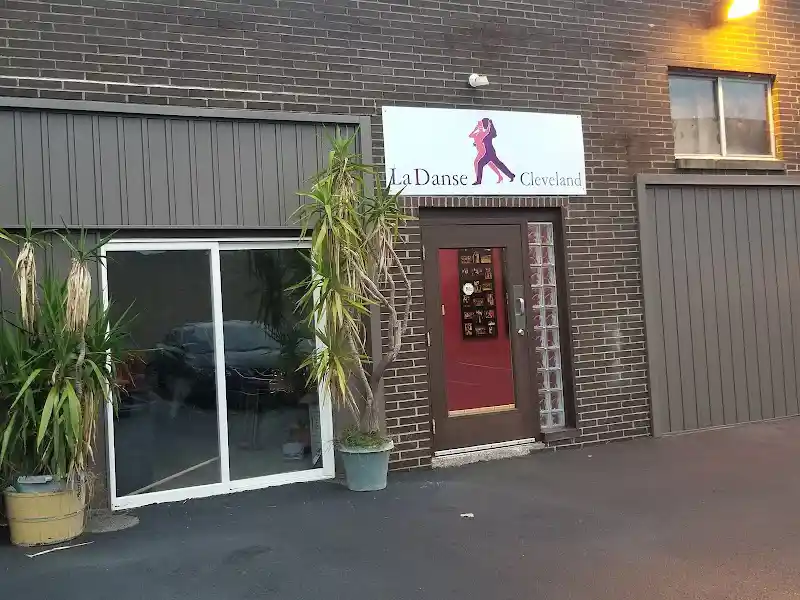
La Danse Cleveland
Address
23366 Commerce Park Road
Beachwood, Ohio 44122
Opening Hours
- Monday: 1:00 - 9:00 PM
- Tuesday: 1:00 - 9:00 PM
- Wednesday: 1:00 - 9:00 PM
- Thursday: 1:00 - 9:00 PM
- Friday: 2:00 - 11:00 PM
- Saturday: 10:00 AM - 10:00 PM
- Sunday: 10:00 AM - 4:00 PM
About La Danse Cleveland
La Danse Cleveland, located in Beachwood, Ohio, is a vibrant dance studio dedicated to fostering a rich dance education and a welcoming community for dancers of all ages and levels. Led by experienced professionals, the studio offers programs designed for both competitive students and those seeking personal enrichment and a love for movement. Co-owner Esther Rehm-Cohen, a certified ballroom instructor since 1981 and former coach of the Case Western Reserve Ballroom Team, brings award-winning teaching experience. Tim Brown contributes nearly three decades of dance expertise, including professional competition and studio operation, creating informative, humorous, and fun classes. Weekend instruction is enhanced by Suzanne Gelinas and Jim Ferris, owners of Always Dancin'. While specific dance styles are not explicitly detailed in the provided content, La Danse Cleveland's commitment suggests a diverse curriculum potentially encompassing popular genres such as Ballet, Jazz, Hip Hop, Contemporary, and Tap, catering to all skill levels from beginner to advanced. The studio aims to be a cornerstone of the dance community, providing enriching experiences that promote artistic expression and physical development.
Styles offered at La Danse Cleveland
Programs from La Danse Cleveland
44 programs available
Classes
introductory dance class
Receive your first introductory dance class for only $25. Please fill out the form and one of our instructors will contact you to schedule your class.
Club/Latin
Aerobics
Peabody
Salsa
Hustle
Wedding Dance
Corporate Events
Private Group Events
Night Club 2 step
West Coast Swing
Mambo/Salsa
Bolero
East Coast Swing
Rumba
Cha Cha
Quick Step
Viennese Waltz
Foxtrot
Tango
Waltz
Dance Parties
Group Lessons
Private Lesson
We invite new clients to experience a $25 thirty minute private lesson designed for you to meet your instructor, see the studio and decide if what we have to offer is what you are looking for!
Hustle
Most Disco dances have strong roots in Swing. The Hustle is believed to have originated in New York in 1970. It went through many incarnations in the seventies, with line dances for groups of people, solo movements that came and went, and partnership dances. Hustle is danced to the contemporary pop, Hip Hop, or “House” dance music of the last 20 years. Most People dance New York style or Swing Hustle. It is a fast, smooth dance, which is all about hands. The lady spins almost continuously, while her partner leads her back and forth in a “slotted” linear formation.
West Coast Swing
Swing is a partner dance dating back to the 1920’s. West Coast Swing is a slotted dance derived from Lindy Hop. The follower travels back and forth along a shoulder-width rectangle, called the slot, with respect to the leader. The leader is more stationary but will move in and out of the slot depending on the pattern led. WCS is characterized by an elastic look that results from its extension-compression technique of partner connection.
Night Club 2-Step
According to Wikipedia, The Nightclub Two Step was initially developed by Buddy Schwimmer in the mid-1960s. The dance is also known as “Two Step”. It is frequently danced to mid-tempo ballads in 4/4 time that have a characteristic Quick-Quick-Slow beat. The dance position for Nightclub Two Step is with a more relaxed hold than typical ballroom dances. The leader rocks back on his left foot, the follower on her right, for one beat. A gentle but noticeable resistance is maintained during the rock step. Then both partners replace weight on the second part of the first beat. On the next beat, the leader takes a step to the left and the follower to the right. Then both partners repeat, but on opposite feet (the man rocks back on his right foot and moves to the right).
Mambo / Salsa
Mambo/Salsa is the latin equivalent of Swing. Perez Prado is thought to have introduced it at La Tropicana nightclub in Havana in 1943. Mambo Mania hit when Prado recorded the song, “Mambo Jambo”. The dance appeared in the United States in New York’s Park Plaza Ballroom, a favorite hangout of dance enthusiasts from Harlem. The Mambo gained in popularity and in the 1950’s was taught in dance studios, resorts, and nightclubs in New York and Miami. In more recent times Mambo has also evolved into Salsa. Salsa is a street version of Mambo. Musically the main difference is that Mambo music holds on the one beat and Salsa music hits on one beat. The steps are pretty much the same. Mambo tends to be sharper in the footwork more time is spent in closed hold and the man breaks on 2. Salsa tends to be sexier, characteristically it has little kick like embellishments, more time is spent in a two handed or apart position and the man breaks on 1. Whether you call it Mambo or Salsa, the small steps are taken ball of foot first with the knees flexible to allow for the hip action known as cuban motion. Mambo is the forefather of Cha Cha. It also shares many patterns in common with the other Latin dances Rumba and Bolero. Mambo/Salsa is fun and flirty and socially is a great dance to learn if you like Latino music.
East Coast Swing
Swing is another all American dance which dates back to the 1920s. We can thank Charles “Lindy” Lindberg (the great American aviator) for creating the Charleston, Shag and the Lindy Hop to go along with Jazz and Blues music. In 1934, Cab Calloway introduced a tune called “Jitterbug” and the name stuck to a 6 count beat variant of the dance. In the 1930s and 1940s, the terms Lindy Hop, Jitterbug and Swing were all used to describe the same style of dancing taking place on the streets, in the nightclubs, in contests, and in the movies. Swing Mania hit and Swing dancing have enjoyed continuing popularity. The character of the Swing is upbeat and fun. It is a happy and playful dance. East Coast Triple Swing and Single Step Swing tend to be very circular in their movements and work more on a 6-count beat basic. The Single Swing, being the closest to the original form, has simpler footwork and is great for dancing to extremely up-tempo music like the old Big Band Tunes as performed by the likes of Benny Goodman and Artie Shaw. The East Coast Swing can be danced to slower, Blues, Rock or Country music. The West Coast Swing and the Lindy Hop are danced more to an 8-count beat and are danced in a slotted fashion – both partners turning 180 degrees during every pattern, to exchange places. West Coast Swing is very smooth and sexy and is quite popular with people who like country and/or funk music. Lindy hop, on the other hand, can be very bouncy and has incorporated the charleston kicks and various acrobatic lifts known as aerials and looks a lot like what we see of Swing in the old B&W Big Band WW2 movies.
Rumba
The word Rumba is a generic term, covering a variety of names for a type of West Indian music and dance (i.e., Son, Danzon, and Bolero). Although the main growth was in Cuba, there were similar dance developments that took place in other Caribbean islands and in Latin America generally. Traditionally, the music was played with a staccato beat using instruments including the maracas, claves, marimba, guiro, cencerro, and bongo or timbales drums. The native Rumba folk dance is very sexual and danced extremely fast with exaggerated hip movements. Today’s Rumba is danced very slowly and has romantic, flirtatious overtones. The American style version is done in a “Box” pattern to a Slow Quick Quick timing. In the Ballrooms we call it either the “Dance of Love” (because you stare into each others eyes as you dance) or “The Ladies’ Dance” (because is shows off women to advantage). Many modern Country, Soul and Latin love songs are Rumbas. The music has a slower Slow Quick Quick rhythm and therefore more exaggerated use of Cuban motion (hip movements) and a more fluid arm styling. The Rumba is a spot dance like most of the Latin dances, which means that it does not travel around the room.
Cha Cha
The Cha-cha is the youngest of the “Latin” dances. It is a true American dance, developed in the dance studios in the early 50’s as a mid-tempo variant between Rumba (a slow dance) and Mambo (a very fast dance). It is believed to have started as a step in Mambo – a triple step to replace the slow one to accommodate slower musical rhythms. This developed into an entirely new dance in it’s own right. Slower modern music has often inspired the evolution of popular dances such as Single Swing into Triple Swing and Quickstep into Slow Foxtrot. Cha-cha music is slower than Mambo/ Salsa but not much. It is quite a common upbeat musical tempo. The dance is alive and well in the Ballrooms today. It is flashy, sassy and full of itself. The Cha-cha styling is very similar to the Rumba and the Mambo. Like most Latin dances, your weight is forward, and most of the movement is below the ribcage. The steps are small, taken with the ball of the foot first to better execute the hip action commonly known as “cuban motion”. Cha-cha music is composed in 4/4 time. The rhythm is danced 2-3-4 & 1 or “rock step cha cha cha”. Cha Cha is a great dance for couples to take up together.
Quick Step
The Quickstep is elegant and graceful yet lively and energetic. It is often likened to the Foxtrot and has dance patterns similar to the Waltz, but danced to 4/4 time as opposed to 3/4 time. This dance has evolved into a very dynamic one with a lot of movement on the dance floor. There are many advanced Quickstep patterns including hops, runs, and steps with rotation. The tempo of Quickstep dance is rather brisk yet should be smooth and glamorous.
Viennese Waltz
The Viennese Waltz is a classic dance, with couples rotating around each other as they glide around the ballroom floor. It was first danced by European royalty and is the only dance of that time which is still performed. The Viennese Waltz is a progressive and turning dance with some figures that are danced in place. It is danced in a fast ¾ tempo fast so the dancers must have a lot of energy and control. Rise and fall is used in the dance but unlike other smooth dances, it does not create a change in height. Rise and fall in Viennese Waltz is created through the knees and body, allowing for a level progression around the dance floor. The Viennese Waltz is both a competitive and a social dance. The International Style Viennese Waltz is danced in a closed dance position with a limited number of allowable figures. The American Style Viennese Waltz is open to greater interpretation both in dance position and movement.
Foxtrot
Foxtrot is known as the social dance for two reasons – the music and the movement. Jazzy big-band music from the 20’s, the crooners from the 60’s and the modern re-workings of classics from the likes of Michael Buble and Postmodern Jukebox all add to the breadth of music that the Foxtrot rhythm can be danced to. Because the basic pattern is easy to pick up and mimics natural walking movements, new dancers find themselves dancing across the floor much more quickly than they thought possible. Although often associated with the style of Fred Astaire or Ginger Rogers who made the dance wildly popular, the Foxtrot was actually introduced into the mainstream by Harry Fox in 1913 in his Vaudeville Routine. Within a sea of other “trots” at the time, “Fox’s Trot” was embraced by the social dancers of the time because of it’s ease of movement and became known simply as the Foxtrot. Foxtrot is a “Ballroom” or “American Smooth” dance, traveling around the line of dance (the general movement around the perimeter of the room in a counterclockwise direction). Smooth in fact is the main descriptor of this dance. The graceful, sweeping movements of the modern version is a far cry from the jerky, energetic antics of the Vaudville original, which make this dance just as popular and useful on the competitive dance floor as it does wherever you find a nice Jazzy tune.
Tango
Tango music originated from Argentine, Brazilian and Spanish influences. The earliest traces of the Tango date back to the latter half of the 19th century-to the Milonga, an Argentine folk dance with Moorish, Arabic and Spanish ancestry. Years later, the Argentine Gauchos (streetwise single men) danced a modified version of the Milonga, in the seedy bars and bordellos of Buenos Aires. The Milonguero dance hold in Artgentine Tango is called “close embrace”, where the couple are literally dancing chest to chest. It gives Tango an immediate intimacy that the other dances do not have. This was considered far too riske for polite society. Tango has a flavor quite unlike any other dance. The basic rhythm is an 8 count Slow-Slow-Quick-Quick-Slow. The music itself leads to excess. It is a dance that is ironically both showy, yet very intimate.
Waltz
The German “Landler”, a folk dance, is supposed to be the forerunner of the Waltz. During the 18th Century, a dance developed, which was called the walzen, German for to roll, turn or glide. The Walzen was met with outraged indignation by the older generation when first introduced into the ballrooms of the world in the early 19th century because it was the first dance where the couple danced in a modified closed position-with the man’s hand around the waist of the girl. Regardless, the Waltz became popular through many parts of Germany and Austria. The Waltz was given a tremendous boost around 1830 by two great Austrian composers – Franz Lanner and Johann Strauss: they set the standard for the Viennese waltz (a very fast version of the Waltz. The first time the waltz was officially danced in the United States was in Boston in 1834 and danced at a leisurely 90 beats per minute. It evolved in America around 1870, and by the 1920’s had slowed down even more to ¾ time with strong accent on the first beat and a basic “box” pattern of forward-side-together-back-side-together. This version of the Waltz retained the characteristic traveling and turning figures and the slower tempo but allowed for more figures including a dip. International style Waltz, like Foxtrot, is danced entirely is closed hold and is most commonly seen in the competitions. American style opens up and allows for under arm turns and much more variety of figures. Waltz is popularly known as the “traditional American wedding dance” and is often used for Father/Daughter and Mother/Son dances. Its characteristic undulating rise and fall technique and shoulder sways gives the dance an oceanic or floating quality.
Let’s Dance! for Friendship
Whether it’s Foxtrot or Salsa, Cha Cha or Viennese Waltz, dancing is a great way to meet people and make friends. In addition to private lessons, we offer many group classes and social parties, so you’ll have an opportunity to rub elbows with (or step on the feet of) a variety of fun and interesting people. Not sure what kind of dancing you will enjoy most? Talk with one of the friendly staff members at La Danse Cleveland. We’ll give you the scoop on a particular dance, or recommend classes that seem to fit best with your skill level, personality, and interests.
Let’s Dance! for Fitness
Dancing can give you a terrific workout and improve your mind-body coordination at the same time. It’s a great way to get (and stay) in shape! Research shows that dancing provides a variety of health benefits, including: Stress reduction Lowering of blood pressure Increased energy More self-confidence Improved strength and muscle tone Dancing burns calories. For example, a 150 pound adult can burn 213 calories doing 30 minutes of moderate social dancing. So, we can give you a fun way to manage your weight (or relieve the guilt of that donut or slice of pizza)! The weight bearing movements of dance steps can also strengthen the bones of your legs and hips, helping maintain health and vitality. If you have any questions about the value of dancing for your well-being, just ask your doctor. Then, we hope to see you soon at La Danse Cleveland.
Let’s Dance! for Fun
Dancing is magical. Whether you are inspired by Ballroom or Latin, Smooth or Rhythm, competitive or social dancing, we’ll help unleash your passion and creativity. Whether you are young or old, novice or advanced, and whether you are single or have a partner, dancing is a fun activity that can make your spirit soar. Dancing adds excitement to life. And yes, anyone can learn to dance! All you need is a desire to learn and a willingness to move. La Danse Cleveland will teach you the rest.
Group Lessons
Whether you want to dance for fun, fitness or friendship, you’ll find that our weekly group classes are an excellent way to learn how to dance, or simply to practice or improve what you already know. In Group Classes, one or two instructors teach a group of students together, and each student has a chance to practice with multiple partners. You do not need a partner to attend any class or party. Group classes are scheduled on a regular basis, usually once a week on a specific day. The schedule of classes for the current month is posted on the calendar in the studio as well as on our website. Don’t let another day go by without the excitement that dancing brings. Enroll in a group class today.
Group Lessons
In Group Classes, one or two instructors teach a group of students together, and each student has a chance to practice with multiple partners. You do not need a partner to attend any class or party. Group classes are scheduled on a regular basis, usually once a week on a specific day.
Private Lessons
Dancing is a great way to stay healthy and have fun at the same time. If you’re a new student, we suggest that you get started with our introductory package. Then, you can decide whether private lessons or group classes make the most sense for you.
Yes, You Can Dance!
This is a community dance program for individuals aged 18 and older with intellectual or developmental disabilities. Enjoy the fun of moving to music in a lively, energetic learning environment under the guidance of trained dance mentors. Dancing is the hidden language of the soul, and we’re committed to enhancing the physical and emotional well-being of individuals with intellectual, developmental, and/or physical disabilities through social dance experiences.
Private Lessons
Private lessons provide the easiest and fastest way to learn because you work at your own pace and on any number of dances that interest you. Private lessons may be scheduled as frequently as you like, from 10 am until 10 pm, 7 days a week, at your convenience. Whether you want to learn the basics, review techniques or hope to gain mastery, private lessons will help you reach your goals.
Frequently Asked Questions
How do I contact La Danse Cleveland?
Call La Danse Cleveland at (216) 464-5325 or visit http://www.ladansecleveland.com/.
What days is La Danse Cleveland open?
La Danse Cleveland is open on Monday, Tuesday, Wednesday, Thursday, Friday, Saturday, Sunday.
What is the best way to contact La Danse Cleveland?
The quickest way is to call (216) 464-5325 or visit http://www.ladansecleveland.com/.
Does La Danse Cleveland have a website?
Yes, you can find La Danse Cleveland online at http://www.ladansecleveland.com/.
Does La Danse Cleveland have Sunday classes?
Yes, La Danse Cleveland is open Sundays: 10:00 AM - 4:00 PM.
More studios near this location
Discover other dance studios around Beachwood, Ohio.