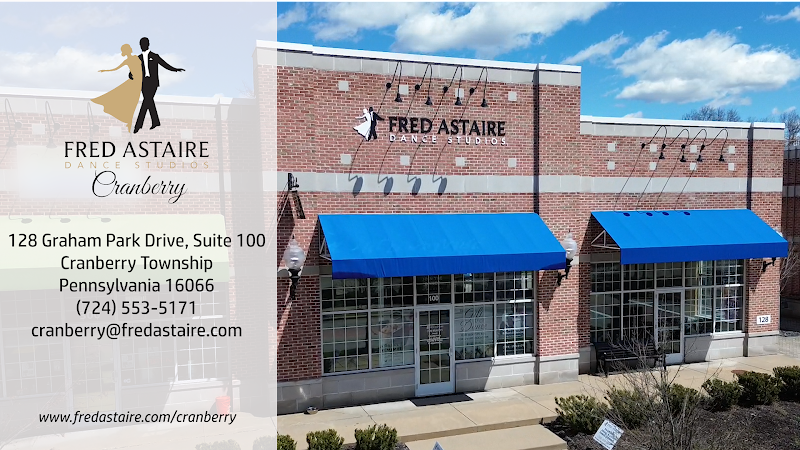
Fred Astaire Dance Studios
Address
128 Graham Park Drive
Cranberry Township, Pennsylvania 16066
Opening Hours
- Monday: 12:00 - 9:00 PM
- Tuesday: 12:00 - 9:00 PM
- Wednesday: 12:00 - 9:00 PM
- Thursday: 12:00 - 9:00 PM
- Friday: 12:00 - 9:00 PM
- Saturday: Closed
- Sunday: Closed
About Fred Astaire Dance Studios
Fred Astaire Dance Studios, located in Cranberry Township, Pennsylvania, invites dancers of all levels to experience the joy and artistry of ballroom dance. Specializing in a comprehensive range of partner dances, their expert instructors guide students through the elegant movements of Ballroom, the passionate rhythms of Salsa, and the vibrant steps of Bachata. Whether you are seeking to learn for social events, personal enrichment, or competitive aspirations, Fred Astaire Dance Studios offers a welcoming and supportive environment. The studio is dedicated to providing high-quality instruction, fostering a love for dance, and helping each student discover their potential on the dance floor. With a focus on both foundational techniques and performance, dancers can expect a rewarding journey of skill development and confidence building at this premier Cranberry Township dance destination.
Programs from Fred Astaire Dance Studios
83 programs available
Classes
Two-Step
Country Western
Quickstep
Viennese Waltz
Waltz
Foxtrot
Tango
Argentine Tango
Smooth
Bachata
Jive
Paso Doble
Bolero
Samba
Cha Cha
Rumba
Merengue
East Coast Swing
Hustle
Mambo
Salsa
Rhythm
West Coast Swing
West Coast Swing (or Western Swing) quickly gained popularity across the U.S. because of its sophisticated style and easy adaptation to contemporary rock music. A regional style popular on the West Coast of the U.S., the dance made a bid for national recognition in the late 50s and continues to grow in popularity in the 21st century. West Coast Swing incorporates many forms of swing including the Lindy, Shag, Whip and Push. Versatile dancers, eager to display their talent, are continually innovating new and interesting movement in swing. After nearly five decades, Western Swing has endured the test of time, and as with the Eastern Swing, it is possible to dance in a relatively small area. The West Coast Swing is danced in place in a slot. Its slower tempo allows for freer rhythmic interpretations using single, double, triple and various other syncopated rhythms. A relaxed, sometimes shuffling movement and upright position are characteristic. Occasional use of hip movements and or push style is also used to enhance the style of the dance.
West Coast Swing
Waltz
The Waltz dates back to the country folk dances of Bavaria, some 400 years ago, but was not introduced into “society” until 1812.
Viennese Waltz
The Viennese Waltz, as its known today, was first danced by European royalty during the era of the Austrian composers, Johann Strauss I and Johann Strauss II (1800s). Its hallmark charisma and social grace is typical of that period of history. The Viennese Waltz became the only dance of that era which is still performed by the American public.
Tango
The Tango made its first appearance during the greatest period of the dance evolution in American history (1910-1914). It was instantly a hit with the dance-conscious public for its intriguing, asymmetrical, and sophisticated patterns which added a touch of romance to the country’s dance consciousness.
Argentine Tango
The Tango made its first appearance during the greatest period of the dance evolution in American history (1910-1914). It was instantly a hit with the dance-conscious public for its intriguing, asymmetrical, and sophisticated patterns which added a touch of romance to the country’s dance consciousness.
Samba
When the Brazilian Samba was first introduced to the U.S. Dance Masters in 1929, it became an overnight sensation. Like many other Brazilian dances, the music is an amalgamation of African and Latin American rhythm that is adorned with expressive, melodic lines. In form, the Samba is a serenade; the repetition of its melody is continually interrupted by the strumming of a guitar or other stringed instruments. Originating in Bahia, Brazil, the dance first became popular in Rio de Janeiro, and later, its intoxicating rhythm was taken up by serious Latin American composers. The Samba is festive and lighthearted, and performed today in all parts of the world. It brings to mind pictures of Rio’s festive and exotic Carnival! In its native land, the Samba is usually danced to a moderately slow tempo which contrasts vividly with the spirited version favored in U.S. The Samba has withstood the test of time and still ranks high among social as well as competitive dancers.
Spicy Salsa Moves
Oozing with a sensuous style, Salsa has it all – passion, energy, and joy. As a dance form, Salsa has its origins in the Cuban Son and the Afro-Cuban dance, Rumba. As it relates to the popular music style, Salsa is continuously evolving, and new modern dance styles are associated and named according to the geographical areas that they are developed in. Some of the popular Salsa styles are Cuban, Columbian, Los Angeles, New York (or Eddie Torres Style), Palladium, Puerto Rican, Rueda, and On Clave.
Guaracha-Rumba
Son-Rumba
Bolero-Rumba
Bolero-Son
Rumba
Rumba (or “ballroom-rumba”), is one of the ballroom dances which occurs in social dance and in international competitions. It is the slowest of the five competitive International Latin dances: the Paso Doble, the Samba, the Cha Cha, and the Jive being the others. This ballroom Rumba was derived from a Cuban rhythm and dance called the Bolero-Son; the international style was derived from studies of dance in Cuba in the pre-revolutionary period which was then popularized by the descendants of African slaves of Cuba.
Quickstep
The Quickstep, with its roots in Ragtime, was developed in the 1920’s in New York from a combination of Foxtrot, Charleston, Peabody and the One-Step. Originally it was danced solo – away from the partner, but later became a partner dance.
Paso Doble
The Paso Doble (or pasodoble), in its classical form dates back many centuries and was originally intended for use at bullfights when the matador was victorious in the arena. The music adapted itself so beautifully to the dance that the villagers danced to the exciting, lively music for hours on end.
Merengue
Both Haiti and the Dominican Republic claim Merengue as their own. According to Haitian lore, an earlier ruler of their country had a lame son who liked to dance. In order that this beloved prince would not feel self-conscious about his affliction, the entire populace took to dancing as though they all were lame. The Dominican’s version is that the dance originated at a fiesta that was given to honor a returning war hero. When the brave warrior rose to dance, he limped on his wounded left leg. Rather than make him feel self-conscious, all the men present favored their left legs as they danced. In both countries for many generations, the Merengue was taught and danced with these back stories in mind. When couples got up to dance the Merengue, the man favored his left leg and the lady favored her right leg; while flexing their knees a bit more than usual and at the same time leaning the body slightly to the same side. Haitians and Dominicans alike refer to the Merengue as their “singing dance;” this is understandable when you consider the exhilarating brightness of the staccato rhythm. The Merengue is danced in place to Latin music.
Mambo
No other dance from south of the (U.S.) border has ever attained the instantaneous popularity than the zestful Mambo did when it was first introduced from Latin America. The extent of the Mambo’s reach can be observed by the widespread use of its rhythm by Tin Pan Alley. Love ballads were written to a slow Mambo beat, novelty songs to a fast Mambo beat, and rock ‘n’ roll numbers were being tailored to the tempo. Across the nation, dancers who had never progressed beyond the Foxtrot and Waltz were clamoring for Mambo instruction. The Mambo can be danced according to the individual dancer’s temperament. Conservative dancers can stay in a closed position, while the more daring can perform steps that break apart and completely separate themselves from each other. Spins and turns are quite popular with Mambo dancers. Ready to take your first step towards a new and exciting lifestyle? Contact us, at Fred Astaire Dance Studios. Inside our Cranberry doors, you’ll discover a warm and friendly atmosphere that will inspire you to reach new heights, and have lots of fun doing it!
Jive
Jive evolved from the popular American dances of the 1930’s such as Jitterbug, Boogie-Woogie, Lindy Hop, East Coast Swing, Shag, Rock “n” Roll etc. Eventually all of these styles of dance would be coupled under the Hat of “Jive”, but in the 1940’s a combination of these styles was given the name “Jive” and the dance was born. During World War II American G.I’s took the dance to Europe where it soon became very popular, especially among the young. It was new, fresh, and exciting. It was adapted by the French and became very popular in Britain and eventually in 1968 it was adopted as the fifth Latin dance in International competitions. The modern form of ballroom jive is a very happy and boppy dance, with many flicks & kicks. The Jive music is written in 4/4 time and should be played at a tempo of about 38 – 44 bars per minute. A spot dance not moving along the Line of Dance. Relaxed, springy action is the basic characteristic of the International Style Jive with lots of flicks and kicks in the advanced style.
Hustle
A new type of touch dance without a name was being exhibited by females. This simple 6-count step with a very basic form, including inside and outside single turns, would give birth to what would later be called “Hustle.” As it began to gain popularity and more people began to participate, the Hustle started to evolve.
One-Step
Polka
Foxtrot
The Foxtrot dance step was named after Harry Fox, a vaudeville dancer and comedian who was believed to be the first to use the “slow step.” This marked a new phase of ballroom dancing where partners danced much closer together and ad-libbed to the new and exhilarating music. The accent has been placed on smoother dancing and individualized expression.
East Coast Swing
Eastern Swing or East Coast Swing (or just Swing), evolved from the Lindy Hop and is perhaps the most famous American folk dance. The best known forms of Swing include the Charleston, Black Bottom, and Shag. In the early 1940s, these forms consolidated into what was called the Lindy.
Cha Cha
Cha Cha is a dance of Cuban origin, and derives its name from the rhythm developed by a syncopation of the fourth beat. Cha Cha gathers its flavor, rhythm and charm from a derivation of three primary sources: the Mambo, Rumba, and indirectly, the Lindy (with each being danced to the same one-two-three triple step). The Cha Cha, while sprung up from Latin American roots in Cuba, really flowered under North American influence. While closely identified with the aforementioned Mambo, Cha Cha has enough intrinsic individuality to be classified as a distinct dance. Much has been written about the history of the Rumba and the Mambo, while little has been explored about the origins of Cha Cha, despite it being a dance to be reckoned with. Cha Cha’s tempo is anywhere from slow and staccato to fast and lively. It is very much an on-the-beat dance and hard not to inject one’s own feelings into it. This facet, more than any other, makes the dance fun for people of all ages. It is a real let-it-all-out type of dance. Cha Cha is danced in place as the steps are quite compact, with the feet usually no more than 12 inches apart. Popularized in the 1950’s with music by such artists as Tito Puente and Tito Rodriguez, today it is danced to popular night club kind of music.
Bolero
The Bolero was introduced to a U.S. audience in the mid-1930s; and at that time, it was danced in its classical form, which was performed to a constant beat of drums. It emerged from this classical form to what was called Son, with a faster and livelier tempo (later renamed as the Rumba).
Awesome Argentine Tango
There are many legends and stories about the origins and development of tango. Tango is a dance and music that originated in Buenos Aires at the turn of the century, developed in the melting pot of cultures that was Buenos Aires. The word Tango was used at the time to describe various music and dance.
group lessons
In group lessons, weekly practice parties, regional and national competitions and studio events and outings, you’ll meet a melting pot of people of all ages, with varied cultural and occupational backgrounds.
Ballroom dance lessons
Ballroom dance lessons offer you a great opportunity to expand your social circle, build connections and engage with people in a low-pressure environment, where there are no expectations.
Ballroom dancing
Dance lessons provide an enjoyable escape from your normal daily routine, plus a chance to relax, relieve stress, and concentrate just on yourself. Our students often tell us that even if they’re “not feeling it” when they arrive for a lesson, once they stretch and start dancing, they’re able to forget about the day’s triggers, simply b-r-e-a-t-h-e and let the dance take over.
Dance
Every opportunity to dance – whether during a lesson or a social event, whether with your significant other or a new dance partner – will help improve your comfort level, confidence and communication skills on the dance floor.
Partner dancing
Partner dancing can also decrease loneliness among all age groups, because it’s a goal-oriented social activity that brings like-minded people together. Swedish researchers studying teenaged girls with stress, anxiety and depression saw a decrease in anxiety and stress levels among those who took up partner dancing.
Ballroom dance
Ballroom dance can decrease blood pressure and cholesterol, improve cardiovascular health, strengthen weight-bearing bones, help prevent or slow bone loss related to osteoporosis, lower the risks of obesity and Type 2 Diabetes, and promote increased lung capacity.
Group activities such as ballroom dance lessons
Group activities such as ballroom dance lessons can expand your sense of social “connectedness”, which is beneficial to lowering stress and depression levels. Ballroom dance is similar to the practice of mindful meditation (which has been shown to significantly reduce levels of depression and stress) in that it requires you to fully focus your attention, and be present in the moment.
Ballroom dancing lessons
Ballroom dancing contributes to the build-up of muscle strength because the act of dancing forces a dancer’s muscles to resist against their own body weight. The use of quick steps, lifts, twists and turns, will help you develop more muscle strength in your arms, legs and core as your lessons continue.
Ballroom dance class
A reputable ballroom dance class will typically begin with a few stretching exercises, to get you prepped to execute dance steps with comfort & ease, and to protect against dance-related injury. Beginner dancers especially will notice that the more you dance, the more flexibility and range of motion your body develops.
Ballroom Dancing
Ballroom dancing is that perfect combination of physical activity, social interaction, and mental stimulation, and it can bring so much to your life. It’s a great workout; has documented physical and mental health benefits; can enhance your social life and self-confidence; reduces stress and depression; promotes relaxation; is a wonderful outlet for self-expression and creativity; and it’s FUN!!
International and American Ballroom Styles
At Fred Astaire Dance Studios, we offer instruction in both International and American Ballroom Styles, and then some! And as a Fred Astaire dance student, you choose which dance style you’d like to learn first based on what’s most appealing to you, and your individual dance goals.
Smooth, Argentine Tango, Tango, Foxtrot, Waltz, Viennese Waltz, Quickstep, Country Western, Two-Step
Rhythm, Salsa, Mambo, Hustle, East Coast Swing, West Coast Swing, Merengue, Rumba, Cha Cha, Samba, Bolero, Paso Doble, Jive, Bachata
American Style Ballroom Dance
Here in the United States, ballroom dance adapted into the American Style between 1910 – 1930 mainly due to the influence of American jazz music, a more social approach to dancing and the iconic dance and choreography talents of Mr. Fred Astaire.
International Style Ballroom Dance
The International Style of ballroom dance was introduced in England in the early 1800s and became popular throughout the rest of the world by the 19th century, through the music of Josef and Johann Strauss.
Ballroom Dance Lessons
Ballroom dance can be enjoyed socially and in dance competitions, and is sometimes referred to as “partnership dancing”, because it is a type of dance that requires a dance partner.
Gold
Silver Program
Bronze Trophy Program
Our Bronze Trophy Program enables students to dance on any size dance floor, to any music, with any partner, and feel comfortable and confident. From there, students can continue to the Silver Program and then all the way to Gold!
Beginner and Social Foundation Programs
Our Beginner and Social Foundation Programs teach newer students the step patterns and techniques to move comfortably around the dance floor. From there, students can progress to the Bronze Trophy Program (our most popular!), which enables students to dance on any size dance floor, to any music, with any partner, and feel comfortable and confident.
Practice Parties
Regularly scheduled practice parties complete the information taught in your private lessons and group classes. At Fred Astaire Dance Studio – Cranberry’s practice parties, we turn down the lights, turn up the music, and enjoy time dancing with different people in a relaxed social setting. Practice parties help you “put it all together”, aid with music identification, and help you learn how not to run into other people on the dance floor. Practice parties are a great (& FUN!) way to apply what you’re learning.
Group Classes
Group classes complement your private lessons, because this is where patterns, technique, and style are learned. Group classes also enable you to meet other students with similar dancing goals, develop balance, and learn the mechanics of dancing.
Private Lessons
Private lessons, with one or more dance instructors, give you the specialized and personalized attention to look and feel confident on the dance floor, while developing the ability to lead or follow any partner. In Cranberry, PA we move at your pace, perfecting and polishing your dancing all the while.
Country Western Two-Step
At Fred Astaire Dance Studios, we are experts at all styles of ballroom dance – and can incorporate any one (or more!) of them into your Wedding Dance choreography. From a classic Waltz or Foxtrot or sultry Tango, to a fun & lively Country Western Two-Step and more, our certified Dance Instructors can help!
Tango
At Fred Astaire Dance Studios, we are experts at all styles of ballroom dance – and can incorporate any one (or more!) of them into your Wedding Dance choreography. From a classic Waltz or Foxtrot or sultry Tango, to a fun & lively Country Western Two-Step and more, our certified Dance Instructors can help!
Foxtrot
At Fred Astaire Dance Studios, we are experts at all styles of ballroom dance – and can incorporate any one (or more!) of them into your Wedding Dance choreography. From a classic Waltz or Foxtrot or sultry Tango, to a fun & lively Country Western Two-Step and more, our certified Dance Instructors can help!
Waltz
Explore the Waltz or learn a unique, choreographed, dance that’s personalized to you and/or your dance partner – perfect for First Dance as a couple or simply fun, entertainment for the wedding reception.
Wedding Party Dance Routines
Looking for something really memorable? We can choreograph a “YouTube-worthy” wedding dance for the whole wedding party, that’s set to your favorite music! Extend those special wedding day moments with an awesome routine you’ll want to re-live, again and again.
Father/Daughter & Mother/Son Dances
A memorable Father/Daughter and Mother/Son dance is a wonderful complement to your First Dance. Including your parents (or the special friends or family members who will be standing in that traditional role) in your wedding dance is a wonderful way to show your love and appreciation. We’d recommend also scheduling a few wedding dance lessons for them, too.
First Dance
Your First Dance is an everlasting expression of your love and commitment – for you and your new spouse, as well as for the special guests celebrating with you. From a few simple steps to get by to a fully choreographed routine, we can help make your first dance as unique as the rest of your wedding day.
Wedding Dance Lessons For Couples
Explore the Waltz or learn a unique, choreographed, dance that’s personalized to you and/or your dance partner – perfect for First Dance as a couple or simply fun, entertainment for the wedding reception. Learn to dance for an upcoming wedding today by submitting the form below to learn more and book your first dance lessons.
Ballroom Dancing
At Fred Astaire Dance Studios, all new dance Students can take advantage of our special money-saving Introductory Offer! Simply complete and submit the Intro Offer form on this website to get yours, and we’ll contact you right away to learn about your dance goals and help you set up your first Lesson. Once you discover how much fun ballroom dancing can be, we know you’ll be back for more!
Wedding Dance Classes
Looking to create a lasting memory from your wedding? Fred Astaire offers classes for your wedding dances that will make you look awesome. Talk with us to get started today and we will work with you!
Ballroom dance
Learn how to ballroom dance. Our certified instructors and unique teaching method help you learn and retain more, faster – regardless of your age, dancing skills or physical abilities. Learning how to ballroom dance is always fun!
Romantic wedding dances
Learn how to dance for your wedding, a new hobby, a fun and engaging way to exercise, a great way to connect or re-connect with your partner, to improve your social life, or to bring your dancing skills to the next level.
Frequently Asked Questions
How do I contact Fred Astaire Dance Studios?
Call Fred Astaire Dance Studios at (724) 553-5171 or visit https://www.fredastaire.com/cranberry/.
What is Fred Astaire Dance Studios's phone number?
Reach Fred Astaire Dance Studios directly at (724) 553-5171.
What is the best way to contact Fred Astaire Dance Studios?
The quickest way is to call (724) 553-5171 or visit https://www.fredastaire.com/cranberry/.
What days is Fred Astaire Dance Studios open?
Fred Astaire Dance Studios is open on Monday, Tuesday, Wednesday, Thursday, Friday.
Does Fred Astaire Dance Studios have evening hours?
Yes, Fred Astaire Dance Studios offers evening hours. Monday: 12:00 - 9:00 PM, Tuesday: 12:00 - 9:00 PM, Wednesday: 12:00 - 9:00 PM, Thursday: 12:00 - 9:00 PM, Friday: 12:00 - 9:00 PM.
More studios near this location
Discover other dance studios around Cranberry Township, Pennsylvania.