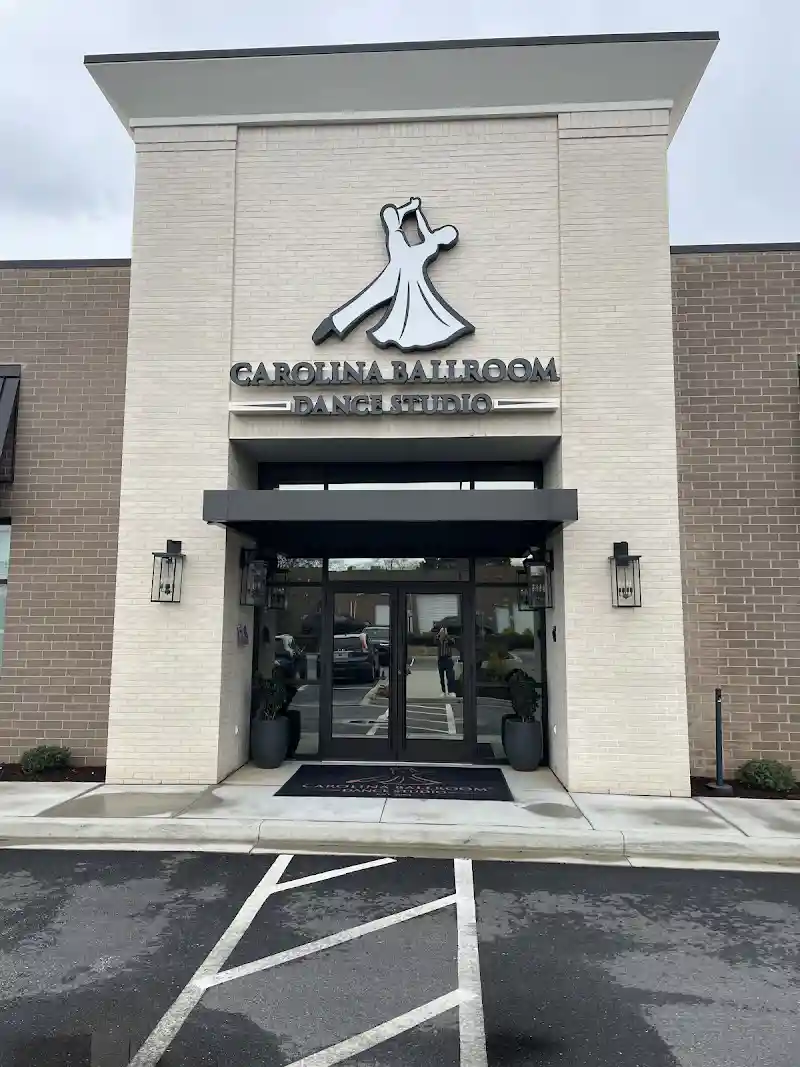
Carolina Ballroom Dance Studio - Dance studio in Greenville, South Carolina
Google Maps

Carolina Ballroom Dance Studio

Verified
Address

134 Halton Road

Greenville, South Carolina 29607

Opening Hours
  • Monday: 12:00 - 9:00 PM
  • Tuesday: 12:00 - 9:00 PM
  • Wednesday: 12:00 - 9:00 PM
  • Thursday: 12:00 - 9:00 PM
  • Friday: 12:00 - 9:00 PM
  • Saturday: Closed
  • Sunday: Closed
35 programs

About Carolina Ballroom Dance Studio

Carolina Ballroom Dance Studio, located in Greenville, South Carolina, offers a comprehensive dance education for enthusiasts of all ages and levels. With a strong emphasis on Ballroom and Latin styles, the studio provides extensive training in American Smooth, American Rhythm, International Standard, and International Latin, alongside social and competitive ballroom dancing. Students can explore a diverse curriculum including Waltz, Foxtrot, Tango, Salsa, Bachata, and Swing. Beyond ballroom, the studio offers classes in Ballet, Tap, Hip Hop, Jazz, Contemporary, Lyrical, Modern, Musical Theater, K-Pop, Acrobatics, Barre, Breakdance, and Flamenco, as well as fitness-focused Zumba and energetic Belly Dance. A dedicated faculty includes accomplished instructors such as Miriam Marie, Alex Zhylenko, Vlad Andriushchenko, Dmitri Naumov, Marco Dal Pezzo, Lena Skrypnyk, Yevhenii Davydenko, Alan Beardsley, Mariana Arbuz, Grygorii Kalinichenko, Sofia Morgul, Oleg Skrypnyk, Maryna Ferris, and manager Nickolai Scherban. Specialized coaching is also available with visiting instructors like Jessa Mae and Jamiee Tuft, catering to competitive dancers and championship aspirations. Carolina Ballroom Dance Studio is committed to fostering well-rounded dancers through private and group classes, preparing couples for their first wedding dance, and hosting public dance events to encourage 'floorcraft' and confidence. This vibrant community setting provides a welcoming environment to discover a passion for dance and refine skills.

Programs from Carolina Ballroom Dance Studio

35 programs available

Classes

Foxtrot

The Foxtrot is one of the most deceiving dances. It looks very easy, but is one of the most difficult dances to do. The dance originated in 1913 when a vaudeville performer by the name of Harry Fox performed a little trot which appealed to the social dance teachers in New York and thus the Foxtrot was born. It has gone through many changes since that time, and is now comprised of more soft and fluid linear movements.

Quickstep West Coast Swing

Social Ballroom, Latin and Swing Dancing | Wedding Preparations | Ballroom Competitive Dancing | High-level Championship Coaching

East Coast Swing

This dance is frequently referred to as Triple Step swing due to the rhythm of the basic triple step. This dance consists of six and eight count patterns, which require a rock step back by both man and woman to begin. It is a circular dance that is danced with a bounce and is very grounded and not high in the legs. This bounce requires the dancer to stay very smooth and not jump around much. East Coast swing is the base for all swing dances.

Rumba

Jive

Cha-cha

An exciting, syncopated, Latin dance, which originated in the 1950s as a slowed down Mambo, the Cha-cha gathers its personality, character, rhythm, basis, and charm from two major dance sources. It is a derivation of the Mambo through its Latin music, and it is also a stepchild of the Swing, as it is danced to a 1-2-3 step rhythm. The Cha-cha gets its name and character from its distinct repetitive foot rhythm.

Merengue Salsa

Social Ballroom, Latin and Swing Dancing | Wedding Preparations | Ballroom Competitive Dancing | High-level Championship Coaching

Bolero

Originally a Spanish dance in 3/4 time, it was changed in Cuba, initially into 2/4 time, then eventually into 4/4. It is now presented as a very slow type of Rumba rhythm. The music is frequently arranged with Spanish vocals and a subtle percussion effect, usually using Congas or Bongos.

Foxtrot, Salsa, Waltz, Swing, Tango, Cha-Cha, Hustle and Rumba
$100.00

You will get introduced to the variety of most popular social dances such as Foxtrot, Salsa, Waltz, Swing, Tango, Cha-Cha, Hustle and Rumba. Couples and Singles invited! Come join the fun, learn to dance!

We schedule all 3 private lessons within 7-day period for the material retention.
first wedding dance lessons

Salsa dance lessons

Swing dance lessons

Latin dance lessons

Ballroom dance lessons

West Coast Swing

This dance consists of six and eight count patterns, which are done in a slot. The woman no longer rocks back as in East Coast swing, but instead she always walks forward on count one. This dance is usually done to medium tempo swing music, frequently slower than East Coast swing. However, those who achieve a high skill level in this dance can and do dance it to faster tempo music. This dance has no bounce and a very smooth feel. Rarely will you see high kicks or moves which require the dancer to leave the floor.

Hustle (Disco)

The Hustle (Disco) is a member of the Swing family and is like the West Coast Swing in pattern. It has a distinct flavor, utilizing Disco style music & revived partner style among nightclub dancers in the 70s. Hustle is danced to the contemporary pop dance music of the last 20 years. It is a fast, smooth dance, with the lady spinning almost constantly, while her partner draws her close and sends her away.

Lindy Hop

This dance came about with the big band era and is danced to fast tempo swing. Most Lindy steps are eight count patterns done in a circular fashion with a lot of kicks, flicks, hops, lifts, and drops. Its been said that this dance gained its name from Charles Lindbergh and his flight to the United States.

Jive

This dance is the European version of East Coast swing. Six and eight count patterns make up this dance, as in East Coast swing but it is quite bouncy with very sharp kicks and flicks. Unlike East Coast swing, Jive is danced to a faster tempo swing music and is meant for competitive style dancing.

Shag

The Shag, which developed on the crowded floors of dance clubs, is called a slot dance because it is danced with both partners moving up and down on a single line or track. If you imagine yourself dancing on a single railroad tie, it will help you to remember to stay on your track. This slot helps the dancers to dance within a very small space without bumping into each other. The slot can rotate and change, however, it is important to remember that each partner continues to dance on a slot in relation to each other. This slot is an area about 6 feet long and 3 feet wide. If the floor is very crowded this slot area decreases. If the floor is not crowded a larger slot area is acceptable. In any type of partner dancing, there are basic elements that together make the dance flow. These elements are clean footwork, the correct timing, a strong dance position, and good lead and follow. There are many different patterns and movements in Shag dancing. The patterns mainly include different types of turns for both man and woman.

Rumba

The Rumba was originally a courtship, marriage, and street dance that was African in origin. The Rumba met some opposition from society’s upper crust because of the suggestive body and hip movements. The characteristic feature is to take each step without initially placing the weight on that step. Steps are made with a slightly bent knee which, when straightened causes the hips to sway from side to side, in what has come to be known as Cuban Motion.

Mambo

The spicy Mambo as we now know it grew out of the Danzon (national music of Cuba) and grasped the imagination of the American dance scene at the close of World War II. Later, fast Swing-Jazz and upbeat Latin music joined in to form the updated and uninhibited Mambo. The Mambo is a spot dance, and the steps are quite compact.

Samba

The Samba is a lively Brazilian dance which was first introduced in 1917 and was finally adopted as a ballroom dance by Brazilian society in 1930. It is sometimes referred to as a Samba, Carioca, a Baion or a Batucado. The difference is mainly in the tempo, since the steps in all four dances are very similar. The style is to bounce steadily and smoothly in 2/4 meter. They say that the Samba was introduced in the United States in 1939 by the late Carmen Miranda.

Paso Doble

The Paso Doble is a theatrical Spanish dance that characterizes the man as the matador and the lady as his cape. Based on Flamenco dancing, the character of the dance is arrogant and passionate. Paso Doble translates to “Double Step”.

Merengue

The Merengue is a popular dance of Haiti and the Dominican Republic and is a truly lively Latin dance. There is an old tale about a very brave and famous military officer who was wounded in battle and developed a limp. A celebration dance was given for the great hero returning from the war. Rather than embarrass their hero, who limped on his wounded leg while dancing, all the men present favored their leg as well, & thus the Merengue was born.

Salsa

Salsa is the Spanish word for “sauce” denoting a “spicy” and “hot” flavor to this popular dance style to a complex mix of many different rhythms. There are indications the term Salsa was coined by radio disc jockeys in Puerto Rico as early as the 1960’s. Later associated with a New York sound developed by Puerto Rican musicians, Salsa is considered the national music and dance of Puerto Rico. The fusion of an Afro-Cuban beat with enhanced jazz textures results in an aggressive high energy pulse which has become popular everywhere. Many of the patterns are closely related to those of the Mambo and Cha-Cha.

Waltz

The Waltz appeared as a fashionable dance in Bohemia, Austria, Bavaria and other parts of Europe in the late 1700’s. Danced in 3/4 timing, the recurring, even beats of music send the dancers whirling around the floor enjoying the thrill of the Waltz movement.

Tango

The Tango originated in the bordellos of Buenos Aires, Argentina, and is done in a slightly different manner than other dances. The hold is very different, with the lady’s arm under the man’s, which creates a tighter hold for a quick staccato action and stylized poses. The American Style Tango is a progressive moving along the line of dance using body movement. A staccato movement of the feet and flexed knees highlight the dramatic style of the Tango.

The Viennese Waltz

The Viennese Waltz is a fast Waltz which originated in Austria. Joseph Lanner and Johann Strauss wrote the first waltzes in the early 19th century. In the middle of the 20th century, the German, Paul Krebs choreographed the Viennese Waltz style to which we dance today. The dance enjoyed a great deal of popularity not only in Europe, but also in America, and has been used in many Hollywood productions.

Quickstep

As the name implies, the Quickstep is a very quick and lively dance, comprised of hops, skips and kicks. The dance began as a quick version of Foxtrot mixed with the Charleston, and musical Jazz influences.

Hustle

The Hustle (Disco) is a member of the Swing family, and is like the West Coast Swing in pattern. It has a distinct flavor, utilizing Disco style music & revived partner style among nightclub dancers in the 70s. Hustle is danced to the contemporary pop dance music of the last 20 years. It is a fast, smooth dance, with the lady spinning almost constantly, while her partner draws her close and sends her away.

Viennese Waltz

The Viennese Waltz is a fast Waltz which originated in Austria. Joseph Lanner and Johann Strauss wrote the first waltzes in the early 19th century. In the middle of the 20th century, the German, Paul Krebs choreographed the Viennese Waltz style to which we dance today. The dance enjoyed a great deal of popularity not only in Europe, but also in America, and has been used in many Hollywood productions.

Mambo Group Class

December 11, 2025
Group Dance Classes

Private dance lessons are, quite possibly, the most important step in becoming a proficient dancer. Your dance instructor will provide you with the personalized attention you need and will direct 100% of their attention to you (and your partner if applicable). No two people learn the same way or at the same rate. Private dance classes offer much more gain in a comparable period of time than any other type of lesson. The general rule of thumb is that you will receive as much from one hour of private dance classes as three to four hours of any other type.

Monday through Friday 12pm - 9pm
Private Dance Lessons

Private dance lessons are, quite possibly, the most important step in becoming a proficient dancer. Your dance instructor will provide you with the personalized attention you need and will direct 100% of their attention to you (and your partner if applicable). No two people learn the same way or at the same rate. Private dance classes offer much more gain in a comparable period of time than any other type of lesson. The general rule of thumb is that you will receive as much from one hour of private dance classes as three to four hours of any other type.

Monday through Friday 12pm - 9pm

Frequently Asked Questions

How do I contact Carolina Ballroom Dance Studio?

Call Carolina Ballroom Dance Studio at (864) 254-0809 or visit https://www.carolinaballroom.com/.

What are Carolina Ballroom Dance Studio's prices?

Classes at Carolina Ballroom Dance Studio start at $100.

What days is Carolina Ballroom Dance Studio open?

Carolina Ballroom Dance Studio is open on Monday, Tuesday, Wednesday, Thursday, Friday.

What city is Carolina Ballroom Dance Studio in?

Carolina Ballroom Dance Studio is in Greenville, South Carolina.

Does Carolina Ballroom Dance Studio have a website?

Yes, you can find Carolina Ballroom Dance Studio online at https://www.carolinaballroom.com/.