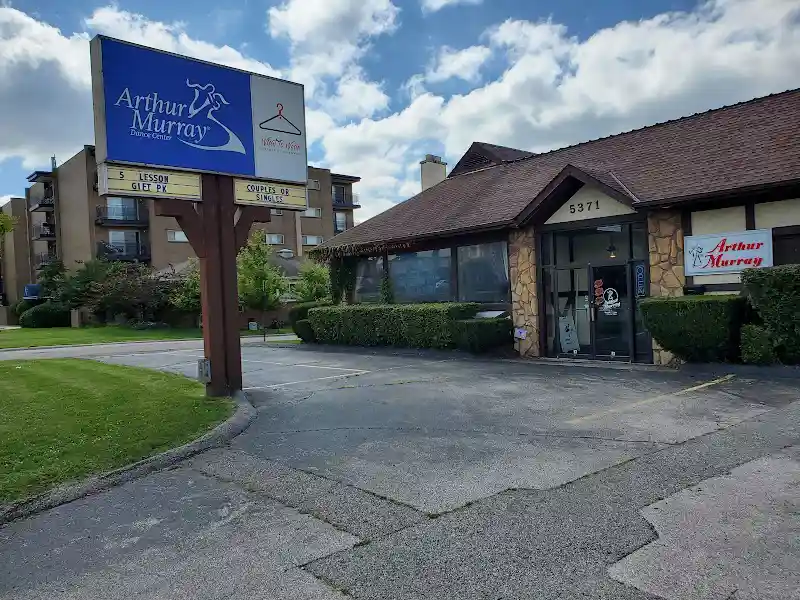
Arthur Murray Dance Studio
Address
5371 North High Street
Columbus, Ohio 43214
Opening Hours
- Monday: 5:00 - 9:00 PM
- Tuesday: 12:00 - 9:00 PM
- Wednesday: 12:00 - 9:00 PM
- Thursday: 12:00 - 9:00 PM
- Friday: 12:00 - 9:00 PM
- Saturday: 12:00 - 4:00 PM
- Sunday: Closed
About Arthur Murray Dance Studio
Arthur Murray Dance Studio in Columbus, Ohio, located at 5371 North High Street, is a cornerstone of the community, offering a rich legacy of dance instruction dating back to the 1940s. As one of the company's earliest franchises and recognized as the #1 most popular dance studio in Columbus by the Consumers Choice Award for 11 consecutive years, Arthur Murray boasts over 108 years of global dance teaching experience. Under the expert guidance of professional teacher Michael Neyer, a 42-year veteran and Arthur Murray Professional Dance Champion, the studio provides comprehensive dance education for enthusiasts of all levels. The studio offers a diverse range of popular and classic dance styles including Bachata, Cha-Cha, Foxtrot, Hustle, Merengue, Quickstep, Rumba, Salsa, Swing, Tango, Viennese Waltz, and Waltz. These are integrated into structured programs from Basic Introductory to Gold, designed to build technique, rhythm, leading and following skills, and styling. Arthur Murray Columbus also caters to specific needs with programs for wedding dance preparation and a Competition Team for advanced dancers. New students are encouraged to experience the joy of dancing with introductory offers, such as '2 Lessons for $45', making dance accessible and rewarding. The studio aims to foster creativity and emotional expression, equipping students with the confidence to enjoy dancing on any floor.
Programs from Arthur Murray Dance Studio
52 programs available
Classes
wedding dance classes
Our dance studio based in Columbus, OH has a staff of professional dance instructors ready to teach you to salsa dance, waltz, rumba, hustle, tango wedding dance classes or get you dancing into better shape for a better you. Dance classes are a great way to meet new people as well!
Latin dance
Arthur Murray Columbus Dance Studio is a great place to learn to dance whether it be ballroom dance lessons or Latin dance lessons. Our dance studio based in Columbus, OH has a staff of professional dance instructors ready to teach you to salsa dance, waltz, rumba, hustle, tango wedding dance classes or get you dancing into better shape for a better you. Dance classes are a great way to meet new people as well!
ballroom dance
Arthur Murray Columbus Dance Studio is a great place to learn to dance whether it be ballroom dance lessons or Latin dance lessons. Our dance studio based in Columbus, OH has a staff of professional dance instructors ready to teach you to salsa dance, waltz, rumba, hustle, tango wedding dance classes or get you dancing into better shape for a better you. Dance classes are a great way to meet new people as well!
Waltz
Viennese Waltz
Tango
Swing
Salsa
Our dance studio based in Columbus, OH has a staff of professional dance instructors ready to teach you to salsa dance, waltz, rumba, hustle, tango wedding dance classes or get you dancing into better shape for a better you. Dance classes are a great way to meet new people as well!
Rumba
Quickstep
Merengue
Hustle
Foxtrot
Cha-Cha
Bachata
Waltz
The Waltz is one of the oldest and most popular ballroom dance styles in the world. Originating among the rural peasant communities of continental Europe, it soon made its way to proper society despite its reputation as an “immoral” dance simply because the dance required the man to put his arm around the woman’s waist. Of course, it has long since lost its veneer of scandal, but even today the Waltz remains an intimate, elegant dance that’s easy to learn and master.
Salsa
Viennese Waltz
The Viennese Waltz is the oldest of the ballroom dances still practiced today. Originally a folk dance in rural Austria and Germany, it’s a fast, vibrant and sometimes dizzying dance that requires quick but smooth and elegant turns. The Viennese Waltz remains a popular choice for dance competitions and ballroom dance scenes in the movies.
Tango
The Tango is a slow, sexy dance that originated in the slums of Buenos Aires in the mid-1800s. It’s become a universal symbol of sexual tension in the movies, but most commonly, is a popular dance in ballrooms and nightclubs around the world. Although many variations of the Tango exist, the most famous is still the original Argentine Tango.
Swing
Swing dancing remains one of the most popular dance styles in modern dance clubs. Three dances in particular make up the basis of Swing dancing: the Lindy Hop, the Charleston and the Jitterbug, but the beauty of Swing dance is that improvisation is encouraged. The basic dance steps of each style are relatively easy to learn, and as you gain more confidence you can layer on different moves as the mood — and the song rhythm — strikes you.
Salsa
The term salsa refers to a variety of Latin dances with origins in Cuba and Puerto Rico, with regional differences both here and in the Latin American region creating a host of different Salsa “flavors.” The mambo, rumba and cha-cha contributed much of the dance’s basic steps, but the word “Salsa” itself is relatively recent, having been coined by an American record company that specialized in that particular style of music. f History of Salsa Dance Forget about health care reform. Want to hear a really fiery debate? Try asking Latin dance experts about the history of Salsa and how developed, and you’ll hear as many theories as there are experts in your sample. What is universally accepted, however, is that contemporary Salsa evolved as the offspring from a number of different Latin dances, from the mambo to the rumba to the cha-cha. Much of Salsa’s origins can be traced back to the creation of the rumba and mambo in Cuba in the 1930s and 1940s. Those dances, of course, grew out of the African slave communities in Cuba, whose ancestors brought their rhythmic instruments and dance moves to the New World in the 16th century. Cuban and Puerto Rican musicians and singers made their way to the American mainland in the 20th century interwar years and forged indelible alliances with the thriving African-American jazz community. Soon, renowned Latin musicians such as Desi Arnaz, Carmen Miranda, Celia Cruz, and Tito Puente had popularized Latin music and dance and brought them into mainstream America. Salsa came into full flower in New York in the 1960s, after Fania Records, an independent label that produced some of the most innovative music of the period. Fania needed a catchy term to attach to its artists’ unique fusion of Latin, Spanish, and African rhythms and styles, and the Salsa craze was born. How to Dance the Salsa/Basic Steps Like most Latin dances, Salsa dance has a number of variations, a testament to its origins as a mélange of different styles. Depending on where you live — New York City, LA, Miami, and all points in between — you might, for example, choose to do either the Step 1 or the Step 2. There are some things to keep in mind when learning to dance the Salsa, though: Although exceptions occur, Salsa music is generally written with four beats per measure, and a full Salsa dance step is performed in two measures of eight beats, with the first measure for the left foot and the second measure for the right foot. Typically, the leader (usually the man) and follower (usually the woman) start in the Closed Position. Here, the two dancers face each other, with the leader holding the follower’s right hand with his left. His right hand rests on the follower’s back, while the follower places her left hand on the leader’s shoulder. Close eye contact is maintained. 3As with many other dances, much of the movement in Salsa dance comes from the hips, legs and feet. Keep your steps loose and fluid, and pay attention to the beat of the music. Salsa dance has plenty of variations, but here’s a basic step (for leaders) that beginners can easily master: Start with your feet in closed position (side by side). Step on the beat with your right foot, while still keeping the closed position. Step forward with your left foot, rocking slightly, your right knee bent. Step on the beat with your right foot. Step your left foot back into closed position. Step on the beat with your left foot. Step backward with your right foot, rocking slightly, your left knee bent. Step on the beat with your left foot. Great Salsa Dance Songs “Coco Seco” – Tito Puente “Cúcala” – Celia Cruz “Déjame en Paz” – Johnny Colon “El Cantante” – Marc Anthony “Hacha y Machete” – Hector Lavoe “Thinking of You” – Lenny Kravitz Salsa Dance in the Movies “Salsa” (1988) “Dance with Me” (1998) “Dirty Dancing: Havana Nights” (2004) “El Cantante” (2006) Learn to Dance the Salsa To schedule your complimentary first dance lesson, fill out our on-site contact form here .
Rumba
The Rumba is a slow, sexy type of ballroom dance that originated in the African slave communities in sixteenth-century Cuba. Although its original incarnation was faster and more aggressive, it remains a sizzling, passionate dance that has influenced many popular Latin American dance moves, including the cha-cha. Many modern versions of the Rumba have successfully married the overt sensuality of its origins with the contemporary preference for slower, more artistic movements.
Quickstep
The Quickstep is a popular ballroom dance that originated in the Charleston and the foxtrot crazes of the 1920s. Faster than the foxtrot, it’s a relatively easy dance to learn but challenging to master, particularly as you progress through the fundamentals. It requires a lot of energy and the ability to dance lightly and gracefully on your feet; the best Quickstep dancers often appear as if their feet barely touch the ground.
Merengue
The merengue is a relatively easy to learn but fun and sexy Latin American dance from the Dominican Republic. Its music’s vibrant, cheerful beat makes it a staple of many weddings, nightclubs and dance parties. The Dominican Republic is generally credited with inventing the Merengue, but variations of it have evolved over the years throughout the Afro-Caribbean region. Its indelible roots in the Dominican Republic, however, are such that its distinctive music — also known as Merengue — is known as the national music of that country. Like many dances that grew out of the slave communities of the Caribbean, the Merengue’s exact origins are unknown. What is certain, however, is that by the middle of the 19th century, the Merengue had become the most popular dance in the Dominican Republic. It’s said that in its infancy ,the dance was not a couple dance but one in which participants — both men and women — moved around in a circle. The music itself was controversial in its early years because of its highly suggestive nature. In fact, its name, perico ripiao, means “ripped parrot,” allegedly taken from the name of a brothel where Merengue music’s roots supposedly began. As it grew in popularity some attempt was made to ban the music, but passion for the dance was such that those efforts failed, and the dance remains a perennial favorite throughout the Latin American and Caribbean regions. In the United States, it’s especially popular on east coast metropolitan cities, particularly New York, where it first took the country by storm.
Hustle
The Hustle peaked in popularity in the mid- to late 1970s, particularly following the release of the film, Saturday Night Fever. It can be danced with a partner or in a line formation, and a number of variations of each style exist, from the New York Hustle to the California Hustle, i.e., the “Bus Stop.”
Foxtrot
The Foxtrot remains one of America’s most beloved dances. Originally a series of relatively quick steps that resembled a trot, it has since evolved to a graceful, sophisticated dance style with long, slow movements. Although flexible enough to be danced to just about any type of music, it’s at its best danced to big-band song.
Cha-Cha
The Cha-Cha is one of the five main Latin ballroom dances most frequently taught in dance schools around the world. The steps are compact and based partly on the Rumba and Mambo, with plenty of hip and pelvic movements. The basic forward movement is supplemented with various turns, dips and slides.
Bachata
Bachata is a style of dance that originated in the Dominican Republic.
Ballroom Style Bachata
A style developed in US/Europe for competition dance only, with very extreme hip movements and lots of Ballroom Dance styling. It is used predominantly for Ballroom competitions rather than social dancing.
Tango Style Bachata
Basic steps, short sequences moving side to side but mostly Tango steps danced like Tango. The “pop” count is used to add elaborated sensuality and varied Latin dance styles but mostly taken from Tango. Although this dance has been used to dance to Bachata, it has evolved to be used to dance to Tango as well. Even though BachaTango is unheard of in the Dominican Republic, Bachata’s country of origin, BachaTango has become popular with foreign instructors outside the Caribbean. A man will indicate dancing tango style by placing his partner’s left arm on his right shoulder and placing his right hand on her back, while holding her left hand with his right and stretching that arm. This position is somewhat similar to that of traditional style bachata, however the upright posture and stretching of the arm indicate tango style.
Modern Style Bachata
This style is also known as Bachata Moderna. Another and more different style originated in Europe (Spain around 2005). The basic is the Traditional Style Bachata added dance techniques and styling from Salsa, Tango, Zouk etc. Steps moving not only left-to-right or on the spot but also moving to different directions and adding basic Tango steps (steps with many crosses), where on each count the male leads to a cross (cross on1, cross on2, cross on3), but on the 4th count keeping the pop or hip movement. For the Lady often danced with very big hip movements, she should picture the number eight when swaying her hips from side to side. A man will indicate switching to modern style by holding both hands of his partner just above the waist level, with her palms facing downwards and his facing upwards similar to one of the hand positions dancing Dominican Bachata in open position. While dancing modern style the hand placement will vary indicating turns, equal to salsa dancing. Modern Style dancers claims that the dynamics of the Modern Style are based on maintaining the essence of the Bachata basic which can be very difficult to see. Nowadays (2010), dancers are also incorporating styling movements borrowed from Zouk-lambada(backwards and forwards bent torso/body movements). You will also meet the term Urban Style, which is Modern Style added some HipHop elements. Characteristics of Modern Style Bachata is that this style mix techniques and styling from many other dances. You will see more or less of the different dances techniques and styling depending of the dancers preferences. The history of Bachata Moderna is described in the article More than just bachata. Modern Style is used for both social and competition dancing.
Traditional Style Bachata
The first Non-Caribbean style developed in US and Europe around year 2000, based on the earlier dominican Bachata but not quite the same. Currently (2009) the most common style of Bachata danced all over the world as it was promoted with music from big Bachata stars such asAventura, Xtreme, Monchy y Alexandra, to name a few. Basic steps moving side to side or on the spot. The main characteristic of this style is the close connection with your partner and dancing also with soft hip movements and a tap with a small “pop” with the hip on the 4th beat (1, 2, 3, Tab/Hip). Traditional Style also includes dips. This is a very romantic style of Bachata, because of keeping the dance close. A man will indicate dancing traditional style by placing his partner’s left arm on his right shoulder and placing his right hand on her back similar to the hand positions dancing Dominican Bachata in very close or semi-close position.
Dominican Style Bachata
The original Bachata dance style comes from the Dominican Republic where the music also was born. The early slow style in the fifties from where everything started was danced only closed like a Bolero. The Bachata Basic Steps moving within a small square (side, side, forward and side, side, back) are also inspired from the Bolero but danced slightly different in Bachata and danced with syncopations (steps in between the beats) depending on the dancers mood and the character of the music. The hand placement will vary with the dancers position which can be very close to semi-close to open. Bachata Dominican Style is today danced all over the Caribbean, now also faster in accordance to faster music, adding more footwork, turns/figures and rhythmic free style moves and with alternate between close (romantic) and open position (more playful adding footwork, turns/figures, rhythmic torso etc.). This style is danced with soft hip movements and a tap with a small “pop” with the hip on the 4th beat (1, 2, 3, Tab/Hip). Can be danced with or without bounce (moving the body down on the beats and up again in between the beats by springs the legs a little). Bachata Dominican is created by the People over many years (from around late fifties) for social dancing and are still evolving. This original style is spreading rapidly in the western world today (2010).
Bachata
Bachata is a style of dance that originated in the Dominican Republic. It is danced widely all over the world but not identically. The basics to the dance are three-step with a Cuban hip motion, followed by a hip tap on the 4th beat just like in other Latin dances (salsa etc.). The knees should be slightly bent so the performer can sway the hips easier. The movement of the hips is very important because it’s a part of the soul of the dance. Generally controlled full body movement is crucially important in the dance, but most of it comes from the hips. In partnering, the lead can decide whether to perform in open or closed position. Dance moves, or step variety, during performance strongly depends on the music (such as the rhythms played by the different instruments), setting, mood, and interpretation. Unlike Salsa (the most traditional Latin Dance), Bachata does not require many complex turns; although they are very well used when the musicality is understood and interpreted correctly. The leading is done just like in most other dances, with a “pushing and pulling” hand communication. If this is done correctly, the follower should clearly understand the intended direction. Although there is a lot of body movement in Bachata dancing, the hand communication is better understood when most of the movement is performed by the lower body (from waist down); i.e. hips and footwork. The new Fusion Styles (mix of different dances) developed in US, Europe and Australia (Traditional, Modern, Urban, Bachatango, BachaBallroom etc.) is a basic dance sequence of a full 8 count in a side-to-side motion. The Original Dominican style basic dance sequence is a full 8 count moving within a square. Counts 1 through 3 and 5 through 7, when taken, generate a natural hip motion. Counts 4 and 8, consists of a tap and can include a “pop” movement depending on individual style. The ‘pop’ can also be executed by lifting the foot while popping the hip to the side opposite of the natural Cuban hip motion. Bachata music has a slight accent in rhythm at every fourth count, indicating when the ‘pop’ should happen. The tab or ‘pop’ is done in the opposite direction of the last step, while the next step is taken on the same direction of the tap or pop. The dance direction interchanges after every 4th count. In social dance, the man can choose to change style within a song. This is usually done after a break or tempo change. Changing style is done non-verbally, by changing hand and body position.
Rumba
If passion is your thing, the steamy music that goes with the rumba will certainly set you in the mood for dancing. The dancers announce their innermost emotions to the rapt audience with a series of powerful moves that match the passionate tempo of the music. The steps are slow and deliberate, as if the two dancers are out to show intimacy.
Hustle
Hail in the disco years, and as the song says, it’s time to “do the hustle.” These dances were very popular at the height of the disco, the 70’s. It has features that are similar to the swing, but it also has a salsa-like rhythm to it. The dance peaked after the famous movie, Saturday Night Live.
Merengue
The Merengue originated in the Dominican Republic and is danced with music that relies heavily on drums, saxophone, and guitars. Its early years was said to have begun in brothels and bars in a city called Santiago. Some also believe that it had been the dance of slaves because the footwork resembles the steps that chained people take as they walk together.
Quickstep
This is the liveliest dance by far. The movements are fast-paced and fluid. You look almost as if you were running and jumping between beats. There is also a constant exchange of fast and slow steps. One look and you’ll certainly be impressed with the dancers because partners are required to heavily rely on each other and work in synch all throughout the dance.
Viennese Waltz
This is a dance that is performed to music that has three beats to the bar. While this may not mean anything to those new at dancing, professionals know that the Viennese Waltz can be very difficult and challenging for starters. Moreover, this is the oldest standard dance that comes with an extremely fast tempo and a progressive rhythm that requires a rotation of turns.
Tango
No other dance shows as much passion as the tango. This the most sensuous dance of all because it requires both dancers to work in unison while keeping close proximity. The dance has its roots set in brothels and massage parlors as the paid women entertained the men who were waiting in line.
Foxtrot
For those who want to learn ballroom dancing, the foxtrot always makes the perfect choice as the first lesson. The performance looks simply graceful and elegant, and this is why it has never lost its appeal over the years. It has four basic elements: glides, slides, long steps, and short steps.
Waltz
If there’s a dance that simply looks classic, that would be the waltz. Bridal parties and formal events usually include this in their repertoire. What it lacks in passion and fizz, it more than makes up for its romanticism. There is a simple and easy-to-follow pattern that helps you move gracefully and effortlessly throughout the dance floor.
Salsa
The name itself indicates that the dance is meant to be saucy and flirty. This type of dancing doesn’t require the use of a large dance floor. Instead, the man and woman hold each other closely and move in a fixed spot on the floor. The salsa is comprised of an eight-beat routine with quick music that may be a little tricky to follow, that is, without the proper tutelage.
Swing
Dancing the Swing usually involves the male dancer and his partner to begin the steps standing at about a 45 degree angle to each other. This means that they mirror each other’s stance before the music begins. Basic footwork entails the first triple step, then the second triple step, and the last rock step to conclude the movement.
Cha Cha
Some dance steps can be little confusing because they can be very similar with the other styles of dancing. The Cha Cha, however, is hard to miss. There are three distinct steps involved, and usually, partners are either asked to face each other or stay side by side. This is usually danced using upbeat sounds as both the boy and the girl must exude flamboyance and playfulness.
Bachata
A style of dance that originated in the Dominican Republic. It is danced widely all over the world but not identically. There are many variations to Bachata. The Modern is a traditional style with salsa, zouk, tango, ballroom, hiphop and reggaeton elements. The tango style is the tango dance with bachata steps and vuelta.
Mambo/Salsa, Swing, Cha Cha, Hustle, Samba
Besides the Waltz and other traditional dances, the Mambo/Salsa, Swing, Cha Cha, Hustle and even the Samba are all applicable to popular music played at weddings today. If you start early enough, you’ll have time to pick up the basics in some of these dances as well.
Gold Program
Our Gold standard is for the hobby dancer interested in performances, exhibitions or competitions. Its intricate patterns can only to be used when both partners are proficient. Choreography, styling, technique and showmanship are necessities in this standard. This material is generally not used on a crowded floor. Although there is a lot of work involved in this program, you will truly be regarded as an outstanding dancer.
Silver Program
Silver is the dance standard with a high degree of styling. More elaborate movements ensure the Silver dancer will stand out on any dance floor. Continuity of movements makes a couple glide across the dance floor with many natural directional changes. Styling, technique, balance and control take on an entirely new meaning. This is the beginning of a more professional style and look on the dance floor.
Associate Bronze Program
The Associate Bronze Program will help you acquire freer movement around the floor while expanding your variety, technique and footwork. Associate Bronze dancers also begin to develop portrayal of a dance’s characteristics in the form of styling. This dance program is very popular with those wanting to get on the dance floor quickly.
Basic Introductory Program
The Basic Program develops the most important dances you plan to use immediately at a basic level. Emphasis is placed on three important elements of dancing; (1) foot position (2) rhythm and timing (3) leading or following with enough variety to keep your learning experience interesting.
Courses
Full Bronze Program
Full Bronze is the complete social dance program taught by the Arthur Murray Dance Studios. It’s designed to develop timing and techniques in all Social Dances selected by the student. The styling will make you look and feel comfortable on the dance floor and strengthen your lead and following regardless of your partner, the music being played or the type of dance floor. Bronze dancers have all the confidence anyone would need on the floor because they have reached the “fun point” in dancing. Dancing techniques at this level will be yours to keep as you’ll never forget the elements of each dance.
Frequently Asked Questions
How do I contact Arthur Murray Dance Studio?
Call Arthur Murray Dance Studio at (614) 847-7541 or visit http://www.ohiodanceinc.com/.
What days is Arthur Murray Dance Studio open?
Arthur Murray Dance Studio is open on Monday, Tuesday, Wednesday, Thursday, Friday, Saturday.
Does Arthur Murray Dance Studio have a website?
Yes, you can find Arthur Murray Dance Studio online at http://www.ohiodanceinc.com/.
Is Arthur Murray Dance Studio open on weekends?
Yes, Arthur Murray Dance Studio is open on weekends — Saturday: 12:00 - 4:00 PM.
Does Arthur Murray Dance Studio have evening hours?
Yes, Arthur Murray Dance Studio offers evening hours. Monday: 5:00 - 9:00 PM, Tuesday: 12:00 - 9:00 PM, Wednesday: 12:00 - 9:00 PM, Thursday: 12:00 - 9:00 PM, Friday: 12:00 - 9:00 PM, Saturday: 12:00 - 4:00 PM.
More studios near this location
Discover other dance studios around Columbus, Ohio.